
Guitar Tone - Midrange
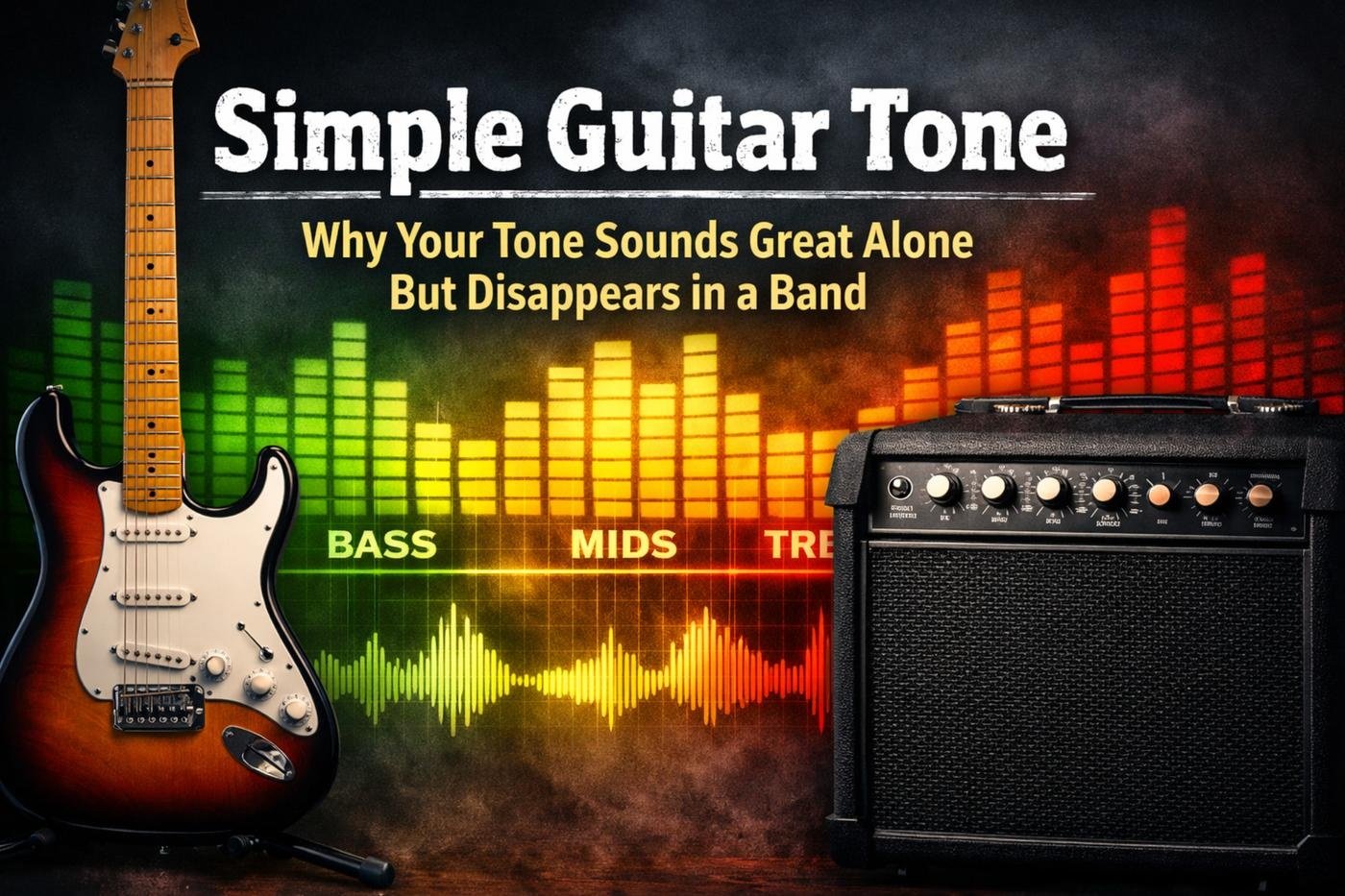
Simple Guitar Tone: Why Your Tone Sounds Great Alone But Disappears in a Band
One of the most common guitar tone mistakes has nothing to do with expensive gear.
It comes down to how you dial in your sound when you’re playing alone versus when you’re playing with other musicians.
If your guitar sounds huge in your bedroom but gets buried in a band mix, this is probably why.
Bedroom Tone
When you’re sitting in your room, the “best” tone usually has a lot of bass and treble. Big lows make the guitar feel full and powerful. Bright highs make it sound exciting and aggressive.
The problem is that your amp EQ controls are not random tone knobs. Bass, mids, and treble all represent different parts of the frequency spectrum.
Think of it like a piano keyboard. The left side has low notes, the right side has high notes. When you adjust your guitar EQ, you’re deciding which frequencies your guitar emphasizes.
That works fine when you’re alone. But it can cause problems the second you start playing with a full band.

Why Guitar Tone Changes in a Band Mix
Every instrument sits in a different area of the frequency spectrum.
A typical mix looks something like this:
- Kick drum and bass guitar dominate the lowest frequencies
- Guitars and keyboards mostly live in the midrange
- Vocals and cymbals sit higher up
So when guitar players turn up the bass, the guitar starts competing with the kick drum and bass guitar. The guitar gets lost because it cannot keep up with instruments designed to fill those lower frequencies.
If you boost too much treble, your guitar starts fighting for space with vocals and cymbals. Most listeners would rather clearly hear the lyrics than a piercing guitar sound.
This is exactly why mids matter so much.
Mids: The Secret to Cutting Through the Mix
The midrange is where guitars naturally sit in a band. If you want to cut through the mix, mids are usually the answer.
When you boost mids, your guitar fits where it is supposed to. Instead of fighting the bass guitar, kick drum, or vocals, it fills its own space and helps the whole band sound better.
The tricky part is that mids do not always sound great when you are playing alone. In a bedroom setting, more mids can sound nasal, boxy, or honky. A lot of players hear that and immediately turn them back down.
But once you play with a drummer, bass player, keys, and vocals, those same mids are often the reason your guitar can actually be heard.
If Your Tone Disappears, Don’t Just Turn Up
If your tone sounds great at home but disappears at rehearsal, the solution usually is not more volume.
Most of the time, the fix is more mids.
Turning up volume without fixing your tone can just make your sound louder and still harder to place in the mix. A better approach is shaping your tone so it sits in the right frequency range from the beginning.
How to Get Better Guitar Tone in a Band
If you want a more usable live tone, here are a few simple ways to get there:
- Use your amp’s EQ to reduce excessive bass and keep your low end tighter
- Do not overdo the treble if it makes the guitar harsh or competes with vocals
- Try boosting mids until the guitar becomes easier to hear in a full mix
- Use an EQ pedal if you want more control over your overall sound
- Use an overdrive pedal that naturally adds a mid boost
Sometimes a simple change in amp EQ is enough. Other times, an EQ pedal or the right overdrive pedal can make your guitar sit much better in the mix.
Final Thoughts
A great solo tone and a great band tone are not always the same thing.
What sounds massive by yourself can disappear once the full band starts playing. That does not necessarily mean your gear is bad. It usually means your tone is built for isolation instead of the mix.
If you want a more effective guitar tone, focus less on huge bass and exaggerated treble, and pay more attention to the mids.
That is often the difference between a guitar tone that sounds good alone and one that actually works in the real world.
[products=amps_midrange]
— Roxy Music


