
How Delay Pedals Work: Type, Time, Feedback, and Mix
There are only 4 things you need to understand to make 90% of delayed tones that you hear. Once you understand how they work, you will be able to create beautiful delay tones.
Before we do that we need to understand what delay is. Delay is an audio effect that takes the signal that you played and repeats it. This repeated signal can make a guitar sound huge, but can make the tone messy. For example, if each note you play repeats forever, playing multiple notes will be a messy wall of sound. This is unusable, but delay done right can create beautiful tones.
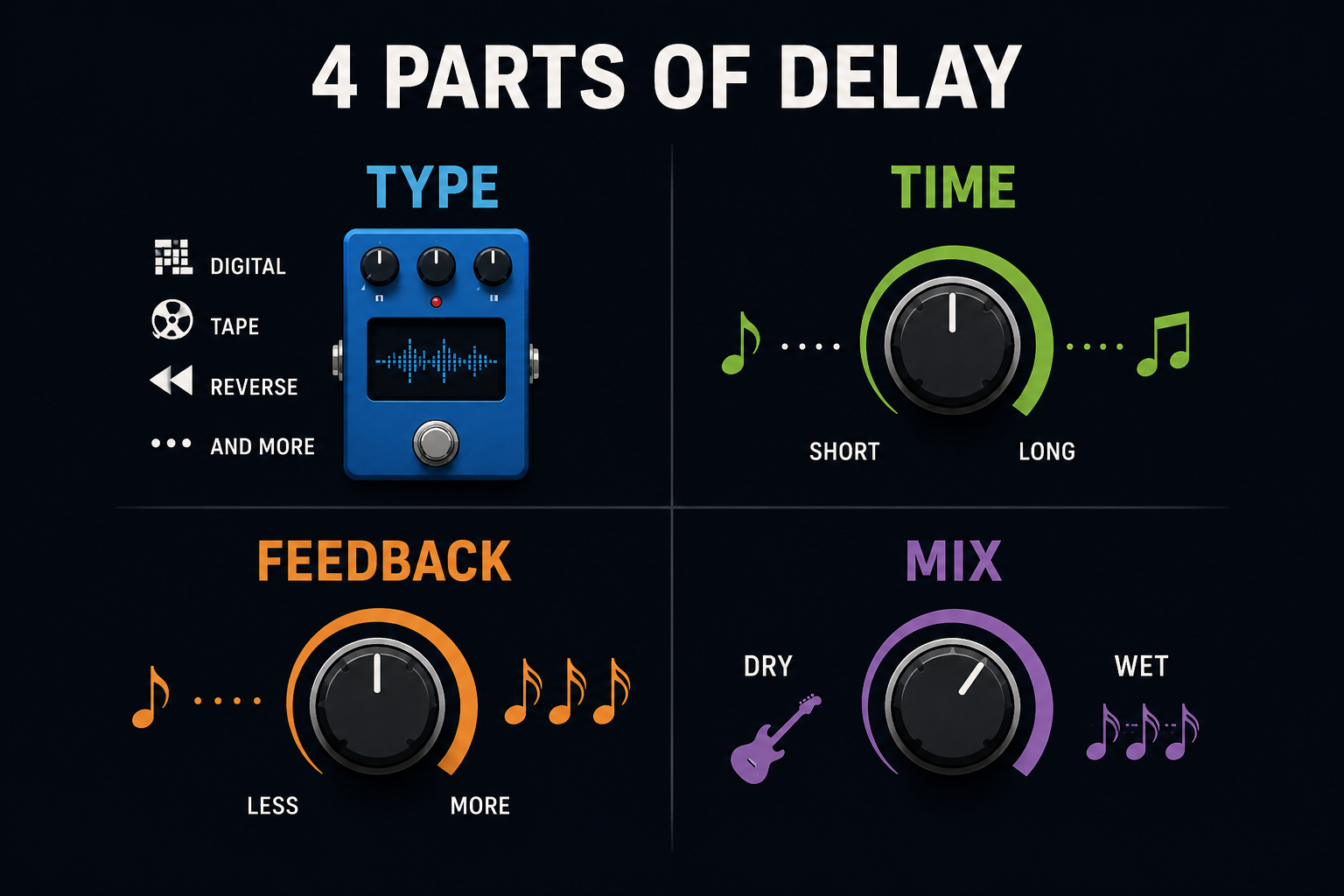
Almost Every delay has at least 4 components. They are type, time, feedback, and mix. If you understand how these work delay becomes so much easier to learn.
Delay Type
Delay Type is what the delayed note(s) sound and act like. Below are 4 different delay types.
-
A digital delay takes a digital copy of the note and repeats it.
-
A tape delay is vintage delay that was actually created with out digital technology. This tape delay has a certain sound that many delay pedals try to emulate.
-
A Reverse Delay takes the original note and the repeats are played backwards. The end of the original note is the beginning of the delayed note and vice-versa.
-
There are other types of delays that are to complicated to explain in this article!
Delay Time
Delay time determines when to repeat the note. A longer delay time means the note will take longer to come out. A shorter delay time means that it will come out faster. Most delays calculate this with the type of note and bpm. For example, you have a quarter note delay at 60 bpm. The delay will calculate how many milliseconds to wait to play the next note.
Some delays don't use notes and bpm. Delay calculators can calculate the number of milliseconds to enter into the pedal.
To figure the type of note you want depends on the style you are going for. Popular delay sounds are:
-
Quarter Note Delay
-
Eighth Note Delay
-
Slapback Delay
-
Dotted Eighth Delay
Quarter Note Delay means that the note will repeat 1 quarter note after you played the original note. Important The length of these notes can change. Setting the bpm will determine how long a quarter note is.
Eighth Note Delay means the note will start 1 eighth note after the original note. It may play multiple repeats of the same note or just 1 (See Feedback to learn more).
Slapback delay is when you play a note. The delay repeats it almost immediately and only repeats it once. 16th notes are usually the best option for this.
Dotted Eighth Delay is when the note plays 1 dotted eighth note after the note you played. Playing Eighth Notes with a Dotted Eighth delay will create a 16th Note Rhythm.
Feedback
Feedback is the number of times the delay repeats. Higher Feedback means more repeats. Lower Feedback means less repeats. A note repeating multiple times is cool but every note you play repeats that many times. This is where delay can become very messy if you are not careful.
The dotted eighth delay uses higher feedback. Slapback delay is very short feedback.
A practical way to set feedback is to play a note on your instrument and then mute it immediately. You will then hear the repeats alone. This will let you count how many times the note is repeated. Slapback delay is once. For solos, I like 3 repeats. Dotted Eighth delay uses about 5.
Mix
Mix is how loud the delay is compared to the original note. Dry signal is what we call the played note. Wet signal is what we call the repeated note(s). Let’s say we set our wet signal to 80% (Very High). This means that the repeated note will be 20% quieter than the original note. If there is more than 1 repeat, the 80% applies to each repeat. The 2nd time a note repeats, it will be 20% quieter than the 1st time it repeated. The Volume will never hit zero with this pattern though. Setting a lower feedback will stop the repeats.
Now that you understand the 4 most important parts of delay, you’re ready to go and make your own. Use the right type, time, feedback, and mix to get beautiful sounds! Keep jammin!


