
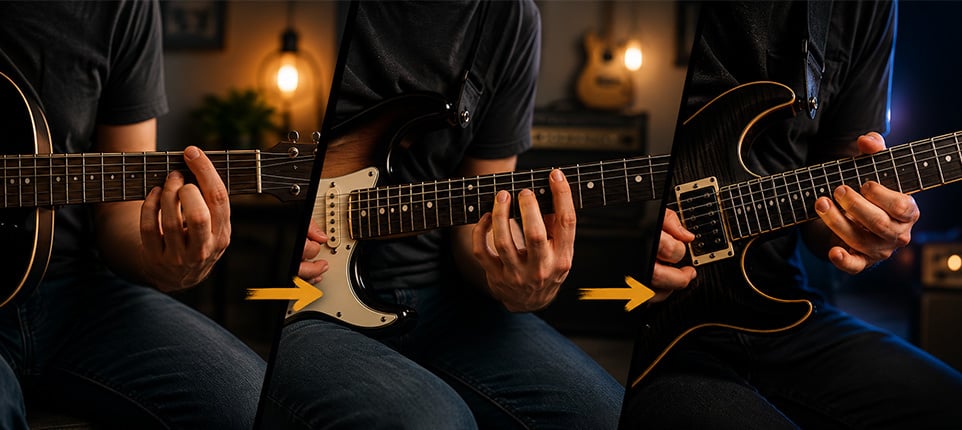
Guitar Techniques That Take You From Beginner to Advanced
Tim Henson, John Petrucci, and Matteo Mancuso are masters at technical guitar. They can play riffs that feel impossible, but you watch them do it and question existence. But, the gap between that and everyone else seems impossible. How do guitar players get from absolute beginners to playing like some of the masters? I can't get you to the masters level, but learning these guitar techniques will help you become a better player.
Holding a Guitar
The first step is to hold the guitar properly. Here are 3 main things to focus on.
-
Proper Thumb Placement
-
Keep Your Fingers Bent
-
Keep the guitar straight up.
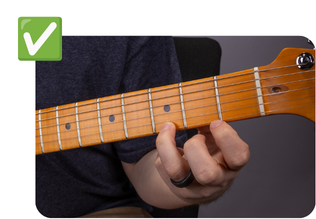
You should place your thumb on the back of the neck straight up, not sideways. Where your thumb goes on the neck can change based on what you are playing, but you rarely want it sideways. Rule of thumb, if your palm touches the back of the neck, the form is incorrect. There should also be a gap between the back of your index finger and the guitar neck. If any part of your finger touches the guitar besides the tip, your technique is wrong. Bring your thumb down on the guitar neck and keep a gap between your fingers.
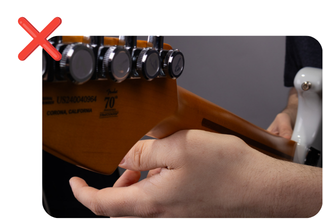
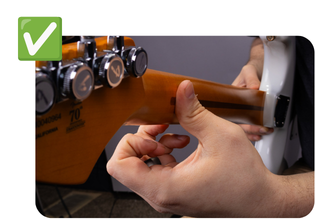
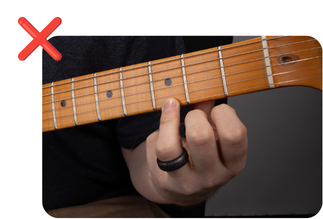
Unless you are playing barre chords, you want to keep your fingers bent whenever you play a note. This means the tip of your fingers touch the strings. Like I mentioned earlier, the only exception is barre chords. You need to keep your fingers straight for them.
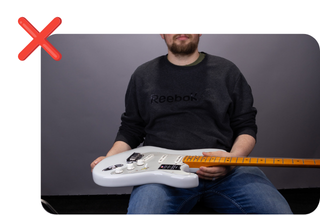
Finally, make sure the guitar stays straight up on your lap. A lot of beginners like to place the guitar flat on their lap. This is a bad practice. Keep the guitar facing the same direction you are.

Picking Styles
On Guitar, there are many different ways to pluck the strings. We are going to cover the main ones here. The first patterns are great for beginners, but they get harder and harder the further we go.
Strumming a Guitar
Strumming a guitar means that you are going to play more than 1 string at a time with a pick.
Most of the time, you will be playing 5 or 6 strings at a time, but you can strum as little as two strings.
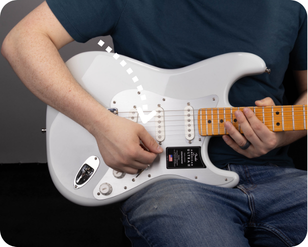
You can strum down.
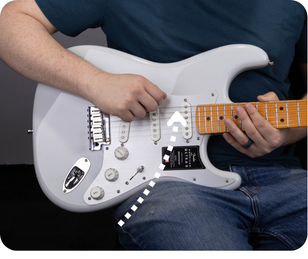
Or you can strum up.
Guitar players use strumming patterns to play interesting strumming rhythms. Below are some common strumming patterns.
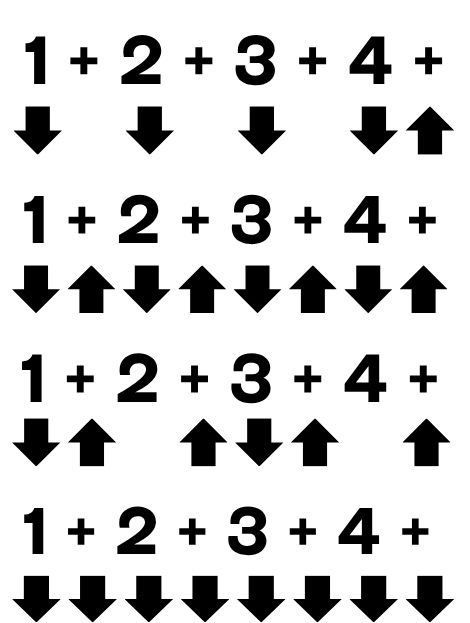
When you can play chord progressions without pausing between chords, you have it down. If you have to pause between chords, you need to either work on switching or the timing of the pattern. Practice them slow enough that you can change chords smoothly. It can be painfully slow at first, but connecting the notes is the most important part. The best way is to play with a metronome, backing track, or other musicians to notice when you get off.
Alternate Picking
Alternate Picking is like strumming, except you only play one string at a time. You can pick down or pick up. This method is very accessible for those who are starting out. You just have to play down then up the whole time. But, it is arguably the hardest method to master.
You always want to continue the alternate picking even when you don't play. If you are playing a rhythm that plays on 1 e a. You want to pick down on 1. Pick up on e. Move your pick down on +, but don’t play. Then pick up on a. This will help you stay in time while playing complicated licks.
Finger Picking
Finger Picking uses your fingers instead of a pick. This is more difficult because you have 5 things that can pluck the string instead of 1. But, you can do cool things like play multiple strings at once. Strumming you can play strings that are next to each other at the same time. Finger Picking allows you to play strings that aren't next to each other. This is not possible while strumming.
To practice finger-picking, try this exercise. These are the chords we are going to use, G, C, D, and Em. Take the root note of each chord. G is on the E string. C is on the A string. D is on the D string. Em is on the E string. After plucking the root note, pluck the G string with your index finger. Then pluck the root note again. Finally, pluck the B string with your middle finger. The pattern for each chord is root note, G string, root note, B string. Practice until you can play it without thinking.
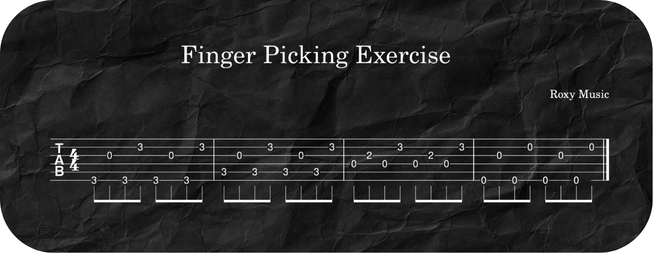
Matteo Mancuso only finger picks. He plays so fast with his fingers that it's hard to hear all the notes.
Hybrid Picking
Hybrid Picking combines finger-picking with playing with a pick. You can use the pick then pluck with your fingers other strings. You can also pluck more than one string at a time. This technique is great for string-skipping. It is hard to skip strings when alternate picking. It is much easier to while hybrid picking.
For this technique, practice Belief by John Mayer. Here is the tab. Use the pick until you have to string skip to the G string. On the notes on the E and A string use a pick. On the G string use your middle finger.
Tim Henson is a master of this style of picking.
Legato Picking
Legato Picking uses Hammer-Ons and Pull-Offs to play very quickly with your left hand.
A Hammer-On is when you play a note by slamming your finger onto the guitar neck without plucking the string. This will still sound like a note, but it does not require you to play the note. It often starts using a plucked note followed by a Hammer-On Note.
Pull-Offs are similar, but instead of slamming a finger onto the string. You lift a finger and pluck the string using the finger that was just on the string. It’s like finger-picking, but you do everything with your left hand.
Legato playing combines picking with Hammer-Ons and Pull-Offs to create very fast licks. Most legato licks start by plucking the first note on each string. Every time you switch strings pick. If you stay on the same string, you can use Hammer-Ons and Pull-Offs. This only requires you to pick at certain times not every note.
Here are some examples of Legato Exercises:
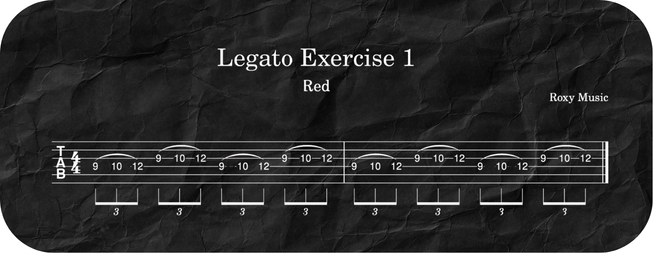
This exercise is fairly simple. Pluck the 9th fret on the D string. Then Hammer-On the 10th fret and the 12th fret of the D string. Do the exact same thing on the G string and repeat.
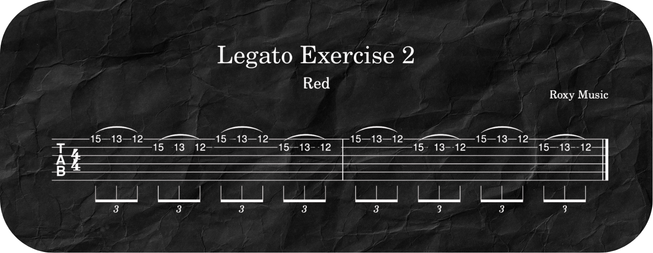
This exercise is also fairly simple. Pluck the 15th fret of the E string. Pull-Off to the 13th fret, then the 12th fret. Do the exact same thing on the B string and repeat.
These exercises came from the Roxy Rockin' Guitar Red Book.
Sweep Picking
Sweep Picking is one of the fastest picking techniques. It is similar to strumming in the you play multiple notes picking the same direction, but you play one note at a time.
You pick multiple notes different strings while picking in one direction. So you can play 1 note per string and pick down for each string. Then come up the strings and pick up for each string.
Here are two beginner sweep exercises:
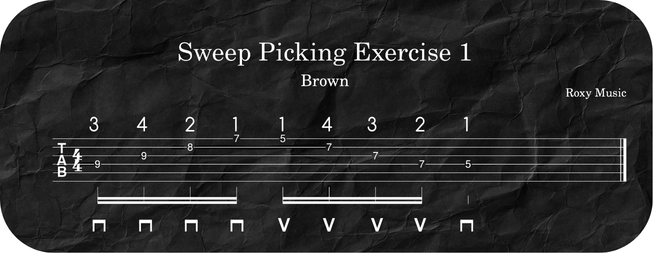
This Sweep Picking Exercise goes across 4 strings. You start on the 9th fret of the D string picking down. You keeping picking down to the 9th fret of the G string. You keep Picking down to the 8th Fret of the B string. You go down one more time to the 7th fret of the E string.
Then you pick up on the 5th fret of the E string. Pick up again on the 7th fret of the B string. Pick up again on the 7th fret of the G string. Pick up one more time on the 7th fret of the D string. Ending picking down on the 5th fret of the D string.
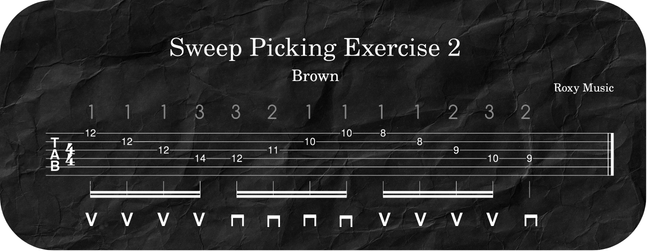
Can you figure out the picking pattern and how to play this riff just from the image?
These sweep picking exercises came directly from the Brown Roxy Rockin' Guitar Book.
Economy Picking
Economy Picking is the mixed-martial arts of picking. It combines sweep picking and alternate picking. When Economy Picking, you switch strings by sweeping to the next string. So you play notes alternate picked on the same string. Then when you wanna go to the next string, you keeping picking in that direction to go to the string.
Here are some examples:
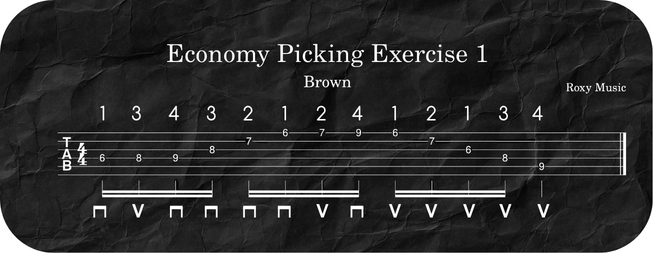
For this exercise, start by picking down on the 6th fret of the D string. Then pick up on the 8th fret of the D string, followed by a Down pick on the 9th fret. Now, we start the sweep section of this economy riff. Pick down on the 8th fret of the G string. Pick down on the 7th fret of the B string and pick down on the 6th fret of the E string.
At this point, it's time to start alternate picking again. Pick up on the 7th fret of the E string. Pick down on the 9th fret of the E string. Then pick up on the 6th fret of the E string. This starts our final sweep pattern. Pick up on the 7th fret of the B string. Pick up on the 6th fret of the G string. Pick up on the 8th fret of the D string. Finally, Pick up on the 9th fret of the A string.
The hardest part about economy picking is when to change strings. If you try to play lower strings, you have to end your alternate picking pattern on an upstroke (or upward pick). If you want to play higher strings, you have to end your alternate picking pattern on a downstroke.
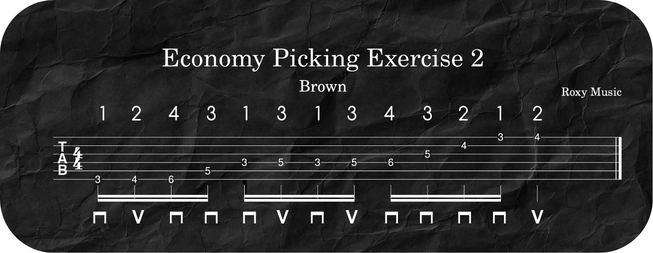
Can you figure out this exercise from the diagram? These Exercises came from the Brown Roxy Rockin' Guitar Book. The Black Roxy Rockin' Guitar goes into more detail.
This article only scratches the surface on the possibilities of these guitar techniques. But, mastering them can take a lifetime.
If you want more help and exercises, click the link to get our Roxy Rockin’ Guitar Books!


