
3 Rhythm Techniques Every Guitar Player Needs to Know
3 Techniques to Master Rhythm
Rhythm is arguably the most important skill to learn in music. A right note played out of time can sound worse than a wrong note played in time. But, the difference is that right and wrong notes are more clear cut. Did the note sound good or bad? Rhythm exists on a spectrum. How close are you to your target rhythm? The goal is always to get closer to the rhythm you intend to play.
This article will cover 3 techniques to improve your rhythm. But first, let’s define some common rhythm terms:
Important Rhythm Terminology
Rhythm – A Pattern of Sound or Silence throughout time.
Rhythm is complex; the speed and the structure can change. But it is always a pattern of sound or silence measured through time.
Beat – A repeating unit of time, like seconds.
The Beat is what we count when we play or listen to music. If you’ve ever counted to 4 when listening to music, you’ve counted the beat.
Tempo – How fast the beat is. Seconds are always at a fixed speed. The Beat changes. We measure how fast a beat with tempo.
Beats Per Minute (bpm) - the unit of measurement for tempo. Think of it like distance, you can measure how far someone traveled in miles or kilometers. Tempo is how you measure speed in music, using bpm.
Measure – A Grouping of Beats. How does the song group beats into a pattern? Most songs use 4 beats per measure.
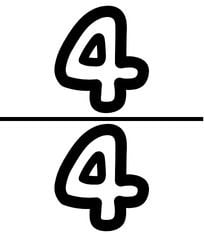
Time Signature – Determines the number of beats in 1 measure. This helps us understand what we count when playing the song. It also determines which written musical term receives 1 beat. Common Time Signature are 4/4, 6/8, and 3/4. 4/4 has four beats per measure in quarter notes. 6/8 has 6 beats per measure using eighth notes as a beat. 3/4 has 3 beats per measure using quarter notes as a beat.
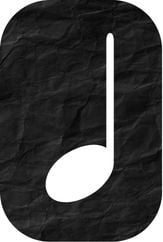
Quarter Note – A Note that usually lasts 1 beat.

Whole Note – A Note that lasts 1 measure in 4/4 time or 4 beats. There are 4 quarter notes in 1 whole note.
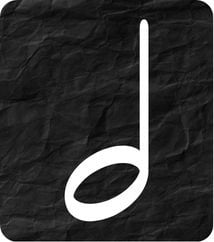
Half Note – A Note that usually lasts 2 beats. There are 2 quarter notes in one half note
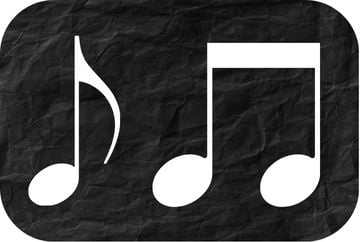
Eighth Note – A Note that usually lasts ½ beat. There are 2 eighth notes in 1 quarter note.

Sixteenth Note – A Note that usually lasts ¼ beat. There are four 16th notes in 1 quarter note, 2 16th in an 1/8 note.
The definitions for the type of notes are simplified. The beat does not have to be a quarter note. It can be an 8th note or any other type of note, but the relationship between them stays the same. A Half Note will always equal two quarter notes
Understanding these terms is important. These words are how musicians talk to each other while playing music. If a musician tells you a time signature and you don't understand what that means you will get lost. If they say, this song is in 4/4, you need to understand that means four beats per measure.
How To Get Better At Rhythm
The first step is counting while you play. You can count to 4 or you can count eighth notes, 1 + (and) 2 + 3 + 4 +. Figure out where each note that you want to play falls in the pattern.
Take this example
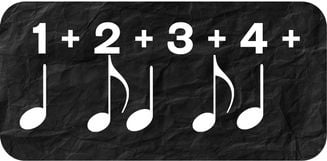
This is the first strumming pattern we give guitar students besides the simple 1 2 3 4 rhythm.
Can you figure out where each strum happens on the grid?
Alright Here it is. You strum down on 1, skip the + of 1. Strum down on 2, Strum up on the + of 2, skip 3, strum up on the + of 3. Strum on 4.
Before you play it, count and clap the rhythm. Count 1 + 2 + 3 + 4 + and clap on 1, 2, + of 2, + of 3, and 4.
The next step is to play the rhythm while counting. Strum in the direction told above while counting the rhythm. Note, you strum down on the beat and up on the + of the beat.
You can use this process for any rhythm.
-
Figure out where you play each rhythm.
-
Clap the Rhythm While Counting.
-
Play the Rhythm while Counting Slowly.
-
Speed it up.
Feeling Rhythm
If you have to count while you play, you aren't feeling the rhythm yet. You're forcing it. Feeling the rhythm means playing it without counting. This means that how well you feel the beat is also a spectrum.
How do we get there? The most important part of feeling the rhythm is moving your body. If you move your body in time, it is difficult to play out of time.
The first thing I recommend every musician to do is start tapping your foot every time you listen to music. The goal is to tap your foot so much that every time you hear a song, your foot starts tapping. It works.
Every time you listen to music, tap your foot to the beat of the song. (If it’s fast, do half notes.)
Sometimes, this may not be enough. You have to learn how to tap your foot while playing which is harder. I’ve had a student for almost 2 years now. He’s grown so much in his learning, but his rhythm is his weakest point. So, we are working on drums right now instead of guitar. We’ve been trying the foot tapping thing, but he’s running into a coordination issue. Every time his hands and feet play a different rhythm, he stops tapping his foot on the beat. The problem is a coordination issue. He is not used to having his limbs play two separate rhythms.
He is practicing drums right now. Drums help solve this issue in two ways. One, he doesn't have to focus on what note to play. Focusing on one aspect makes learning it way easier. Drums also force the player to use multiple limbs. It is great for learning coordination.
Right now he is working on doing four kick drum hits on every beat (Like tapping his foot). Then he is playing 16th notes on the hi-hat. The point of this is to learn coordination.
Moving your body is the secret to feeling rhythm. Start by tapping your foot. If you struggle with coordination, learning a simple drum groove can help you improve. You don’t even need a drumset. You can grab two pens, play 16th notes, and do 4 foot taps.
Common Rhythms
Most music is based on rhythm groupings of 4 or 3. Quarter Notes – 16th notes are groupings of 4. Triplets are groupings of 3.
Below is a chart of every 16th note combination within 1 beat.
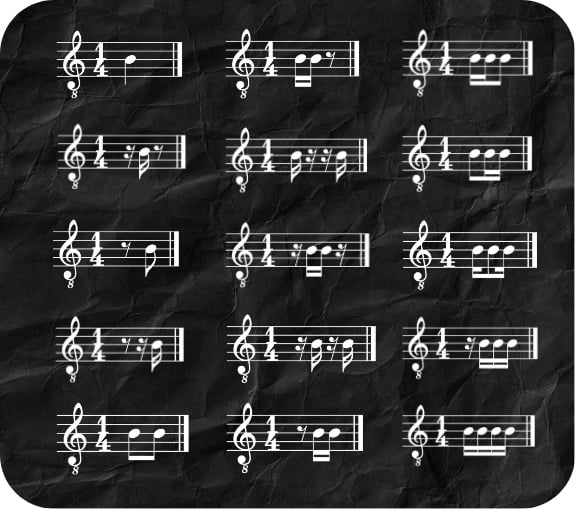
Practice this chart. Take a metronome and clap every rhythm. Play them 4 times per measure.
Count 16th notes like 1 e + a 2 e + a 3 e + a 4 e + a.
Mastering rhythm is very difficult. It often takes years to build an internal time clock that can feel the rhythms we talked about. But, learning rhythm is arguably the most important musical skill. If you want more help with rhythm, click the link and fill out this form to get our Roxy Rockin' Guitar Books.


