
The Circle of Fifths for Guitar Players: A Simple Reference Guide
The Circle of Fifths for Guitar Players
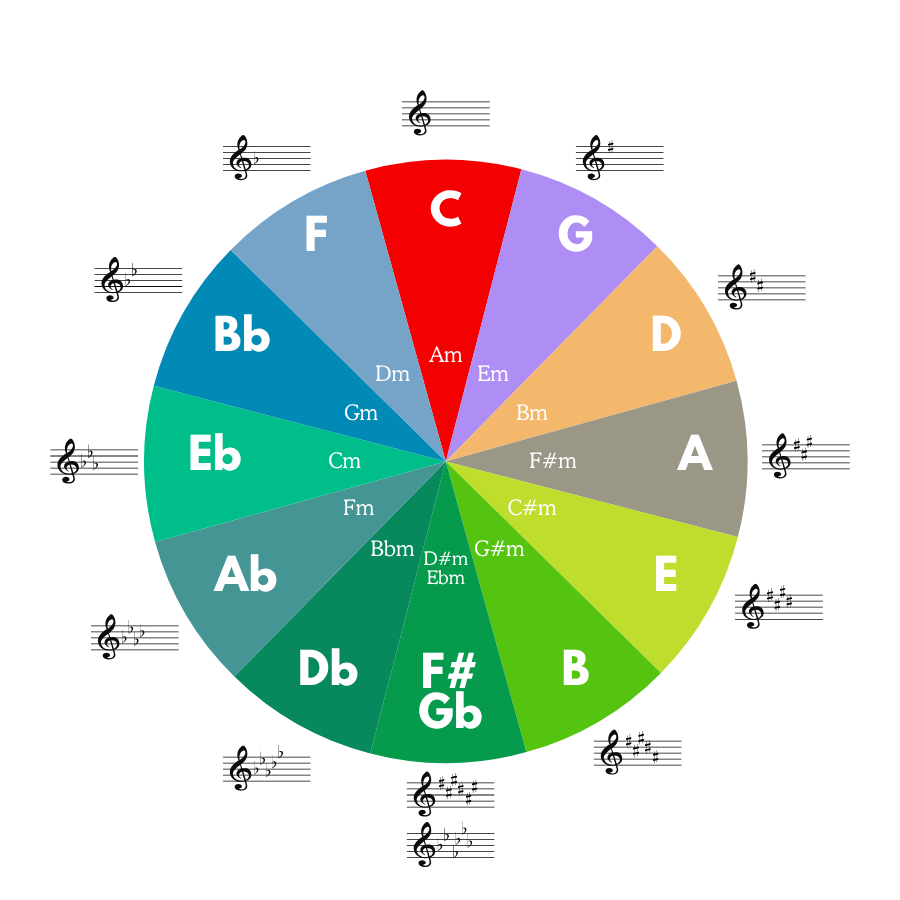
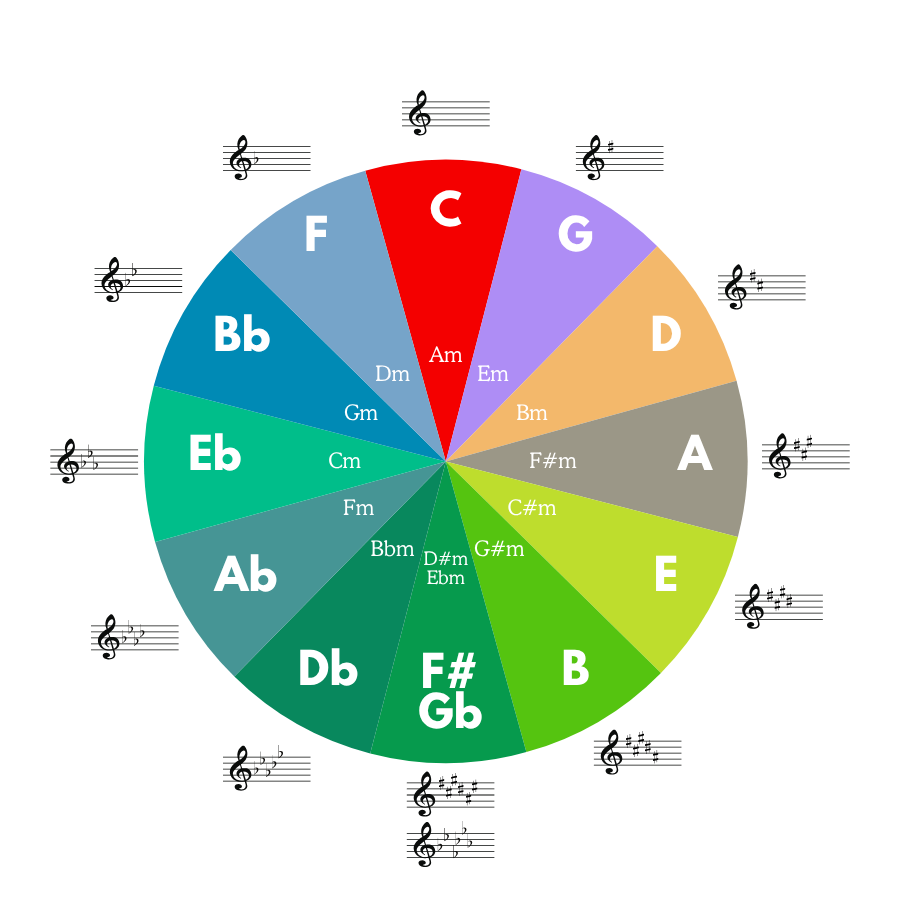
The Circle of Fifths is one of the most misunderstood concepts for guitar players. The truth is guitar players often think it is a mystical music theory artifact. The truth is, on its own, it won’t affect your playing or writing. But it can help you memorize the music theory tools that will.
The Circle of Fifths is a reference table. It is like the Table of Elements in Chemistry or multiplication tables in math. You can use it to remind yourself of certain concepts in music. The Circle of Fifths helps us remember three things:
-
Key Signatures
-
Relative Keys
-
Common Chord Progressions
The Major Scale
Before learning the Circle of Fifths on guitar, you must understand the major scale. The Major Scale is created using whole steps and half steps. A Whole Step is 2 frets apart. A Half Step is one fret apart. Major Scales are created on a pattern of these two intervals. The pattern is Whole Step, Whole Step, Half Step, Whole Step, Whole Step, Whole Step, and another Half Step.
Here’s what that looks like. Let’s take the note C. A Whole Step above C is D. A Whole Step above D is E. A Half Step above E is F. A Whole Step above F is G. A Whole Step above G is A. A Whole Step above A is B. Finally, a Half Step above B is C. This is how Major Scales are formed.
P.S. You will never have two of the same letter in a key. G and Gb will never be in the same key. Use F# instead.
Key Signatures
Key Signatures tell us how many sharps and flats are in one key. The key of C has zero sharps and flats. We just saw it worked out above. Take the same pattern we used for C and try G. How many sharps or flats did you get?
P.S. You won’t have a key with both sharps and flats.
Now that we know about Key Signatures and Major Scales, let’s learn how the Circle of Fifths works. What does fifth mean in this context? It refers to the Major Scale. If we assign numbers to each note in our Major Scale, the fifth note is the fifth. Let’s take C. C is 1. D is 2. E is 3. F is 4. G is 5. A is 6, and B is 7. The fifth note in C is G. Now look at the Circle of Fifths. The note to the right of C is G.
This works in every key. The fifth note is right next to the note on the Circle of Fifths.
The circle is laid out this way because each key gains one sharp as you go around the circle. C has zero sharps. G has 1 sharp. D has 2 sharps and so on. After you complete B, you get F# and Gb. This is a combination key. After Gb, we switch to flat keys. Each key then loses one flat. This is super valuable in memorizing your major scales.
The same way works if you go counter-clockwise around the Circle of Fifths. Every key adds a flat until you get to the F#/Gb connection spot. For now, we are ignoring C# and Cb. They are useless keys that are never used in a practical way. Then you go backwards in sharps until you get back to C.
The easiest way to think about it is clockwise adds sharps. Counter-clockwise adds flats.
Relative Keys
The Circle of Fifths also gives us relative keys. A relative key is the Major or Minor key that has the same key signature. For example, C and Am have the same key signature. You can determine relative keys by finding the 6th note in the Major Scale. The 6th note in C is A. It will help you memorize the relative minor or major of each key.
Common Chord Progressions
Believe it or not, the Circle of Fifths gives us our most common chord progressions. In pop music, the most common chords are 1, 4, 5 and 6m. They appear in almost every song. The Circle of Fifths identifies these chords for us. The one chord is the key you are on. For example, the key of C, C is the 1 chord. The 4 chord is one slot backwards. If you go counter-clockwise by one section of the Circle, you get the 4 chord. In C, the 4 chord is F. The 5 chord is a fifth. This means that if you go clockwise one section on the circle, you get the 5 chord. The 6m chord is the relative minor. We discussed that above. In the key of C, it is Am.
Try to figure out the 1, 4, 5 and 6m chord in the key of E.
Another common progression the Circle of Fifths shows is the 2-5-1 progression. Jazz musicians will understand that jazz is almost entirely based on 2-5-1 progressions. The Circle of Fifths shows us these progressions. In the key of C, D is 2. G is 5 and C is 1. If you find D on the Circle and go backwards one, you get a G chord. If you go backwards again, you get a C chord.
So take your starting note as the 2 chord, then go counter-clockwise once to get the 5 chord. Go counter-clockwise again to get the 1 chord. It works for every 2-5-1 progression.
The Circle of Fifths is not some mystical artifact to play music better. It is a tool to help us memorize important theory topics. Use it to memorize your major scales, relative keys and common chord progressions. If you are looking for more info on these topics, check out our Roxy Rockin’ Guitar Course. You get a pdf book that will help you at your playing level.


