
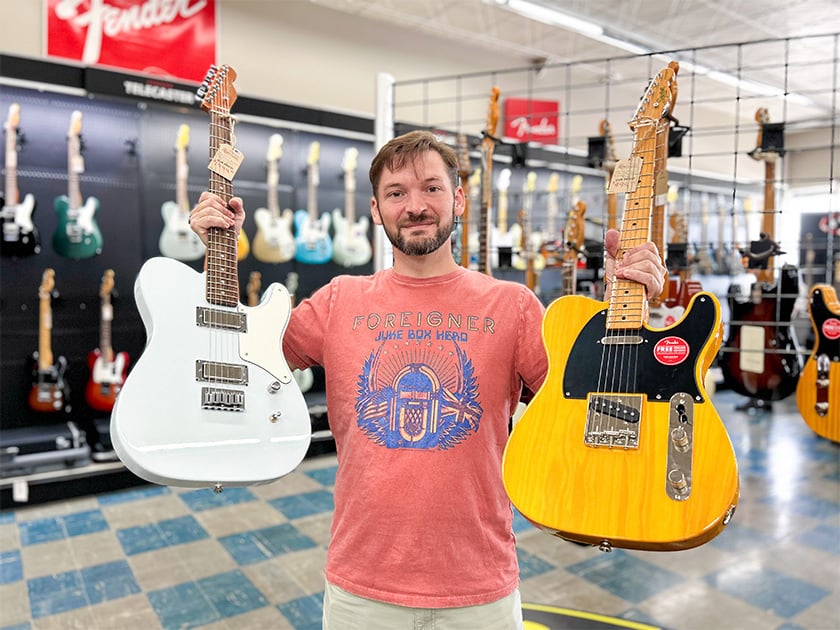
How the Fender Telecaster Started Rock'n'Roll
Fender Telecasters
One of the most popular guitars in the world was once thought of as a joke. The design was so different from the standard mold that people thought it would be terrible. But the Fender Telecaster changed the guitar world. Working through it was worth it. The Telecaster legitimized bolt-on necks, lowered repair costs and created Rock’n’Roll. It all started in 1950 when Leo Fender released the Broadcaster.
The Broadcaster
The Broadcaster was essentially the Telecaster. It had the same shape, headstock, neck, and body. It was released in 1950 under this name. But Fred Gretsch sent a cease-and-desist letter to Fender. Gretsch had a drum set named the “Broadkaster” since the 1920s. Obviously, they didn't want people to be confused about which instrument to buy. This led Fender to have to rethink the name.
In 1950, television was really beginning to boom. Fender took the Tele from there and combined it with broadcaster to make the “Telecaster.” At the time, television was the future. Fender was trying to align itself with the common man. Fender was trying to break away from the old guitar world that was only accessible to the elite. This was a guitar for everyone.
From Rocky Start to Icon
People were skeptical of the Telecaster at first because it had a bolt-on neck and a solid-body. They said the guitar would be better used as a “Boat Paddle.” It was thought of as an inferior model to Gibson guitars at the time. They were expecting a terrible-sounding guitar without sustain.
Then the guitar came out. Players got to try it. The Tele had better tuning stability than the hollow-body guitars, and it was very bright. This allowed the guitar to cut through the mix. It quickly became a staple in the music industry.
The bolt-on necks allowed Fender to mass produce the guitar. This became a real competitive edge as well. Set-neck guitars took weeks to build. It required a luthier to put the instrument together. This advantage allowed Fender to take market control. It also allowed Fender to repair the instruments much faster. If a neck was messed up, Fender didn’t have to have a luthier repair the neck to make it work, or install a new neck. The company could ship a neck to a guitar shop, and the shop could install the neck right there.
The price of the Telecaster was also competitive for a lot of professional musicians. The price was much less than the premium archtops back in the day. The Telecaster sold for about $189.95. This is about $2,100 today. This seems like a lot, but the rivals with premium arch-tops were charging between $300 and $500. Musicians wanting a quality guitar with a unique sound had an easy choice. Fender also had the esquire, which was a single-pickup version of the Tele for about $140.
The Birth of Rock'n'Roll
The telecaster is one of the reasons Rock’n’Roll was born. Before the telecaster, the music scene was all swing music. People wanted to dance. Guitar players were all rhythm players. Most of the guitars were hollow bodies. Hollow-body guitars feed back if the amp is too loud. This meant that a guitar would rarely play the melody or a solo. A guitar feeding back isn’t the sound most swing musicians were aiming for.
The Telecaster changed that. The solid body allowed guitar players to turn up their amps without feedback. This put the guitar front and center. Guitarists became lead players. This paved the way for Rock'n'Roll. Guitarists could use distortion. Plus, even if they turned up the guitar loud enough for the Telecaster to feed back, it would fit the genre.
The Pickup System
The design was so advanced. The outer parts have mostly stayed the same for the last 75 years. The knob layout, on the other hand, has changed quite a bit. In 1951, the selector switch in the rear position activated both pickups. This tone knob didn’t actually affect tone. It was a blend knob for the Bridge and Neck pickup. The Middle switch was the neck pickup in a way we would expect it today. The Neck Pickup switch was still the neck pickup, but it had a bassier tone. This layout was changed in 1952, but the current layout of the telecaster didn’t come until the late 1960s.
Today, the Telecaster remains a staple amongst guitarists. It’s impossible to say what music would be like without the Telecaster. Jazz and swing music might be more popular today, and we may have never gotten rock. Who knows? The importance of the guitar shaped our world today, and it still does. Players like Brent Mason and Brad Paisley use it to play beautiful country licks. Bruce Springsteen plays a Telecaster at every gig for his massive audience.
Do you think a Telecaster is right for you? You can get them at affordable prices with the Fender Squier. If you are looking for a Professional level guitar, the Fender American Ultra II is for you. Shop Telecasters here.


