

How Chords Work: Major, Minor, and Diminished
How Chords Work
When you first start learning guitar, you learn common chords like C, G, Em and D. You probably saw a chord diagram that showed you how to play it. But, you don’t really understand what a C chord is. You know it sounds good when you play it at the right time. But why does it sound that way? What is the difference between a C Major Chord and a C Minor Chord? Knowing how Major Chords work is one of the most important things you will learn. They will help you learn songs faster, play songs in different keys, and solo better. We are gonna learn how chords work, what to memorize, and why they are useful.
Major, Minor, and Diminished
A Chord is 3 or more notes played at the same time. If you play those notes at different times, it’s called an arpeggio. The notes chosen for the chord determine what type of chord it is. The most common chords are Major, Minor, and Diminished. In order to understand how to build these chords, you need to understand intervals. An interval is the distance between two notes. If you want a deep dive on intervals, check out this article.
A Major Chord uses a Major 3rd Interval and a Perfect 5th interval. A Major 3rd is four half-steps from the starting note. If we start on C, four half-steps above C is E. A Perfect 5th is seven half-steps above the starting note. Seven half-steps above C is G. This means a C Major Chord has the notes C, E, and G.
A Minor Chord is similar to a Major Chord. A Minor chord has the root note (C), a Minor 3rd, and a Perfect 5th. This means that C and G will still be in the chord. The E will be different. A Minor 3rd is three half-steps above C. This note is Eb. A C Minor Chord has the notes C, Eb, and G. A Minor chord is notated as a little m, or a -. Cm, C-, both mean C Minor
A Diminished Chord is similar to a Minor Chord. A Diminished Chord uses the root, a Minor 3rd, and a Tritone. A Tritone is six half-steps from the root. Six half-steps above C is Gb. A C Diminished Chord has the notes C, Eb, and Gb. A diminished chord is notated as an °. D° or D dim is a diminished chord.
Important Note: A C chord will always have the letters C, E, and G. This means we can’t use D#. We have to use Eb. We also can't use F#. We have to use Gb. This happens because of a Major Scale. A Major Scale always has to have one of each letter in the musical alphabet. This results in C Major always needing the letters C, E, and G. Check the list below for the required letters in each chord. Flat and Sharp keys will all still have these letters.
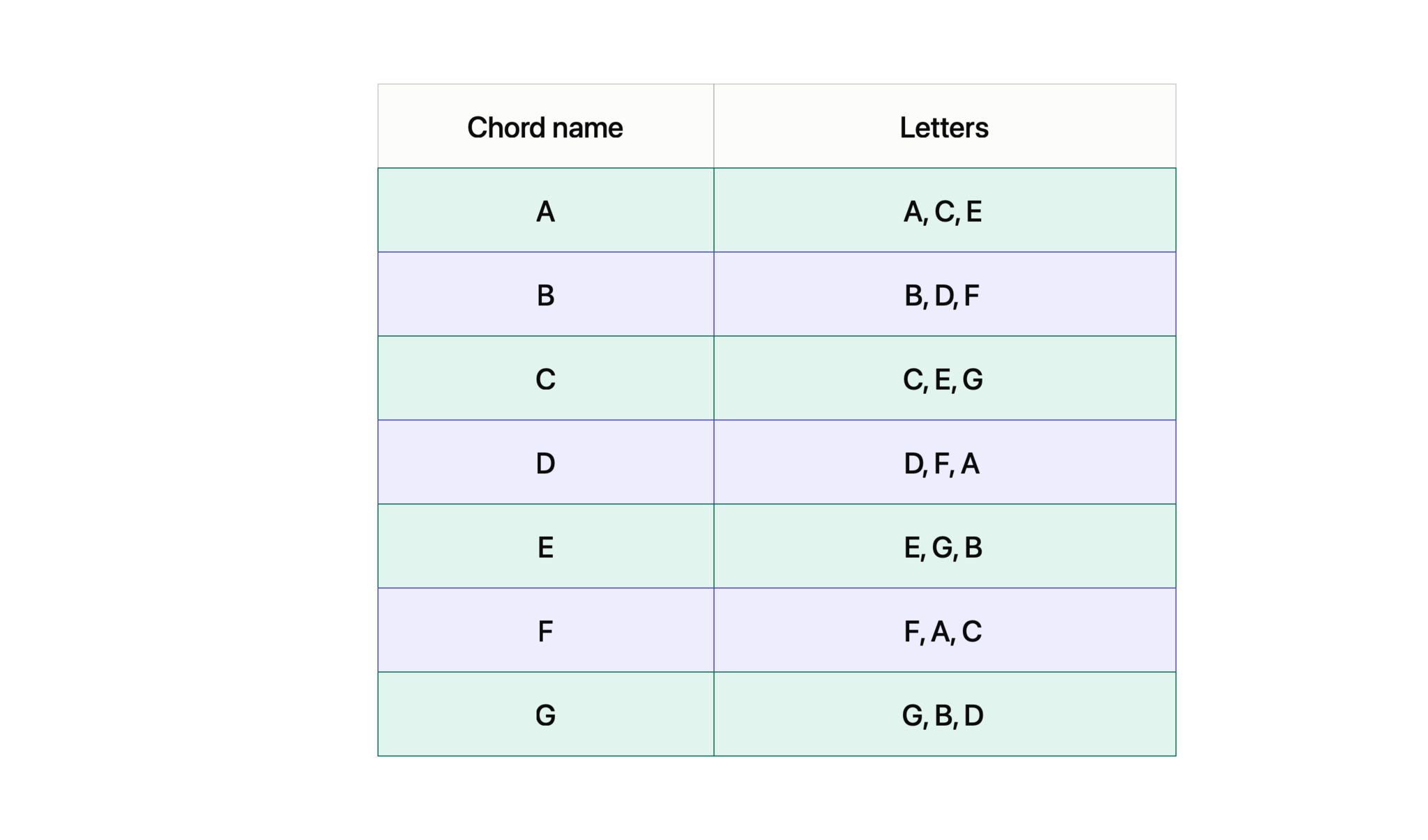
Note: If the chord-name does not say diminished, minor, or some other type of chord, assume it’s major.
Guitar Chords
One thing you may have noticed is that when you play C on guitar, you play more than three notes. A C chord on guitar usually uses 5 strings. Let’s look and see what’s happening.
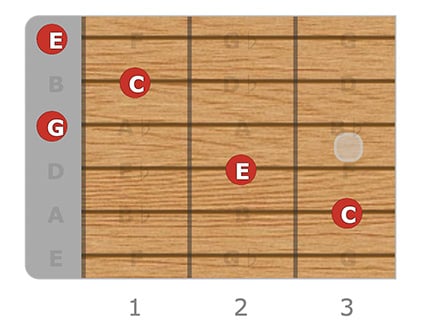
This diagram shows the C chord. If you look closely, every note is a C, E, or G. The 3rd fret of the A-string is C. The 2nd fret of the D string is E. Then we have an open G string. Then the first fret of the B-string is C. Finally, the open E string. Every note is a C, E, or G. This is in fact a C chord. We are just doubling notes.
Let’s look at our G chord.
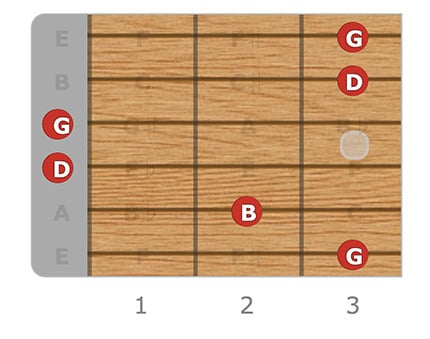
A G chord will have the notes G, B, and D. The 3rd fret of the E-string is G. The 2nd fret of the A string is B. The open D string is D. The Open G string is G. The 3rd fret of the B string is D. The 3rd fret of the E string is G. This is a G Major Chord.
Memorizing Chords
Memorizing the notes in all the chords will help you understand music theory. Personally, I can recite any chord asked about in under two seconds. It is a very useful musical skill.
-
Start with Major Chords
-
Learn Minor Chords
-
Then Diminished Chords
The Benefit of Learning Chords
Learning your chords will help you learn songs faster. Songs appear in patterns. Understanding how chords go together will help you learn them faster. We do this by assigning a number to each chord. A common requirement of musicians is to play a song when someone shouts 1, 4, 6, 5 in the key of C. This can be difficult.
Learning your chords will also help you switch keys. The paragraph above talked about using numbers to play chords. This article doesn't have time to explain how to do that. But, understanding how the numbers work will let you play the song in any key easily. This article will teach you how to read chords like numbers: Major Scales.
Finally, chords will help you play more interesting solos. If you are soloing when the band plays a C chord, what notes should you play? If you want notes that sound good, play the notes in a C chord. If you want to sound dissonant, don't play the notes in a C chord.
Chords are one of the building blocks of music. They are in almost every song. The basics of understanding chords can be challenging. But learning how chords work and memorizing them have a ton of musical benefits. If you want to practice your chord knowledge, click the link to get access to the Roxy Rockin’ Guitar books. (The Chord practice exercises are in the blue book.)


