
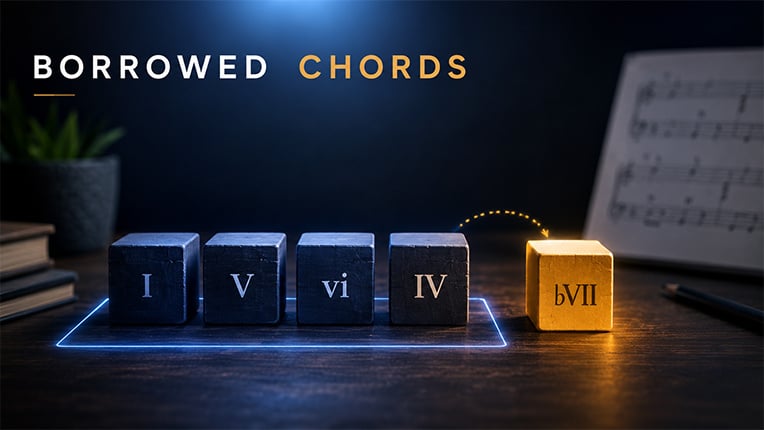
Borrowed Chords: How to Break Out of the Four-Chord Rut
How to use Borrowed Chords
Are you tired of all your music sounding the same? Don’t worry you’re not alone. Pop Music has been critiqued by many musicians over the years because it all sounds the same. The reason is that most pop music uses four chords. These chords sound great, but they can also leave you playing the same exact thing every time. One of the coolest tools to spice up your music is borrowed chords. Borrowed chords let you play interesting chords without sounding too dissonant.
There are three things we need to cover about borrowed chords:
-
Understanding Chords
-
Borrowed Chords
-
Common Practices
Understanding Chords
Before continuing, you will need a basic understanding of major scales. Ideally, it would be better if you memorized all of them. A basic understanding can get you through. If you need help with major scales, check out this article.
You will also need to understand how chords are built. Since you understand the major scale, let’s build all the chords in a single key. Chords are built by using a root note, a major or minor 3rd, and usually a perfect fifth interval. The root name could be any note that you play. A major 3rd is 4 half steps above the root note. A minor 3rd is 3 half steps above the root note. A perfect fifth is 7 half steps above the root note.
The next question to ask is: what does the major scale mean for chords? The major scale determines what chords to play in a key. Let’s take our C Major Scale.
C, D, E, F, G, A, and B.
Each note in this major scale becomes a chord. The first chord in this scale is C. You can figure out the 3rd by going up two notes in the scale, which is E. Then go up two notes again for the 5th, which is G. E is four half steps above C, so it is a major chord. You can do this for every chord in the key. You should try.
The result will end up with C as Major, D as Minor, E as Minor, F as Major, G as Major, A as Minor and B diminished. Diminished happens when the fifth note in the chord is a tritone instead of a perfect fifth. B to F is not a perfect 5th.
A very important skill to learn in music is how numbers relate to chords in a key. It is simple. The 1st note/chord in a scale is the 1 chord. The 2nd note/chord in a scale is the 2 chord and so on. Why this is important is that it follows a pattern for any key. The 1 chord is major. The 2 chord is minor. The 3 chord is minor. The 4 chord is major. The 5 chord is major. The 6 chord is minor. The 7 chord is diminished. This pattern works in any key.
The last thing you need to understand before we explain borrowed chords is the chord pattern in a minor key. Let’s take the key of Cm. It is C, D, Eb, F, G, Ab, and Bb. You can create chords the same way. C to Eb is a minor third, so you have a minor 1.
The chord pattern for a minor scale is the same for every scale. 1 is minor. 2 is diminished. 3 is Major. 4 is minor. 5 is minor. 6 is major. 7 is major.
Borrowed Chords
Borrowed Chords take the chords from the parallel key and superimpose them into your key. In other words, borrowed chords allow you to take chords from either the parallel major or minor key. If you are playing a song in C major, you can take chords from the key of Cm and use them. If you are playing in the key of Em, you can take chords from the key of E major and use them.
We already explained how the major keys and minor keys follow chord patterns. We can interchange some of the chords from these chords to create borrowed chords.
Let’s look at the key of C to keep it simple. We have C major, D minor, E minor, F major, G major, A minor, and B diminished. The key of C minor has C minor, D diminished, Eb major, F minor, G minor, Ab major, and Bb Major. (Notice, the 3rd, 6th, and 7th chords in a minor key are flat. This happens in every key.)
If you wanted to spice up your song, you could throw a D diminished in instead of D minor. Or you could throw Eb instead of E minor. (Remember, you are borrowing the chords from the minor key. To play a borrowed chord, you have to play the notes from that key.)
Common Borrowed Chord Examples
Here are some of the most common borrowed chords in music. The most common one is the minor 4 chord. In the key of C, F is the four chord. If you play an F minor, you have a minor 4. This is one of the most popular borrowed chords. "Wake Me Up When September Ends" by Green Day is one of the most popular songs that uses this example. They are in the key of G. The 4 chord is C major. When they sing, “Wake me up when September Ends,” they play a Cm on September.
Minor 5 is also very popular. In the key of C, G is the five chord. If you play a G minor, you are playing a minor 5 chord. The Beatles use the minor 5 chord in "Strawberry Fields Forever." They play it during “to Strawberry Fields,” lyric in the chorus.
The last most common borrowed chord we will cover is the bM6 to bM7 progression. This takes from the minor scale, but it is popular in Disney songs. It is also known as the “Mario Cadence” because it appears in Super Mario Bros. Look up “Mario Cadence” to hear how it sounds.
Borrowed chords are a great way to step outside of your comfort zone when learning chords. They let you step outside of the typical 4-chord songs in the majority of popular music. Adding a borrowed chord in can change the mood of your song, so experiment and see how it works.
If you are looking for instruments to play these borrowed chords on, Roxy Music has you covered. Guitars from Fender to PRS. Yamaha keyboards and drums that will get you rockin’. Check out roxymusic.com.


