
How to Use Guitar Modes So You Sound Musical
Guitar Modes Explained
Guitar Modes will help you create solos with beautiful note choices. But if you aren't careful, modes can make solos sound like scale exercises. Don’t get me wrong. Scale Exercises are important for learning guitar, but they don’t sound musical.
So how do we learn modes the right way? Here is how we are get there:
-
Defining Modes
-
How to Learn Modes
-
Super Imposing Modes
Defining Modes
Before we dive deeper into modes, it is imperative that you understand how the major scale works. If you aren’t familiar with the Major Scale, check out this article before going further.
The Major Scale determines the notes in a key. For example, the notes in the key of G Major are G, A, B, C, D, E, and F#. This is a G Major scale.
Modes determine what the starting note of the scale is. Most people play the G Major Scale starting on G and ending on G. It is also an Ionian Mode. An Ionian Mode starts on the root note of the key and plays the Mode up and down. If you start on A while playing the same notes, A, B, C, D, E, F# and G. You have an A Dorian mode. Here are a list of all the modes.
Ionian – Starts on the root note of the scale. In the case of G Major, the mode starts on G.
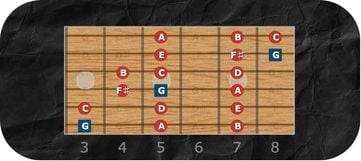
Dorian – Starts on the 2nd note in the scale. In the case of G Major, the mode starts on A.
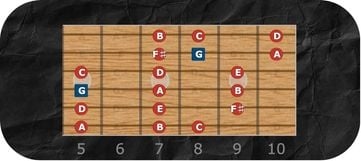
Phrygian – Starts on the 3rd note of the scale. In the case of G Major, the mode starts on B.
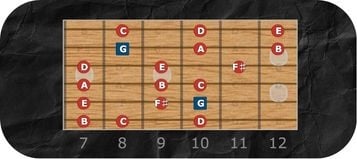
Lydian – Starts on the 4th note of the scale. In the case of G Major, the mode starts on C.
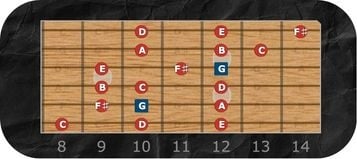
Mixolydian – Starts on the 5th note of the scale. In the case of G Major, the mode starts on D.
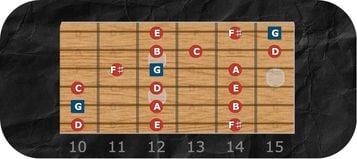
Aeolian – Starts on the 6th note of the scale. In the case of G Major, the mode starts on E. This is also called a Minor Scale.
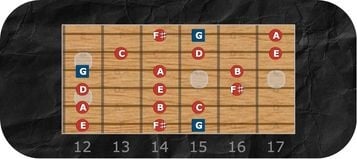
Locrian – Starts on the 7th note of the scale. In the case of G Major, the mode starts on F#.
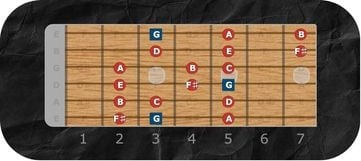
How To Learn Modes
The problem with learning modes like this is that it isn’t a practical way to sound musical with modes. 7 years ago, I was working on getting my bachelors degree in Guitar Performance. My instructor told me that modes can lead to musicians play from the root of the scale. If you play an A Dorian Mode over an A Minor chord, it is very easy to sound like you're just playing a scale. The goal is to play melodies.
This section will cover how to learn the modes in a way we can use them. The important part is to relate each mode to the root note’s Major Scale or the Minor Scale.
Here is an example. The A dorian Mode is the 2nd mode of the G Major Scale. It uses the notes A, B, C, D, E, F#, and G. The A Minor Scale has the notes A, B, C, D, E, F, and G. This means that A dorian has a # (sharp) 6. Sharp 6 means that the 6th note in the minor scale is raised one half step.
How do we determine if we are going to use the Major Scale or Minor Scale? It depends on if 3rd note of the mode is a Major 3rd or Minor 3rd above the root note. A to C is a Minor 3rd, so we use a Minor Scale. Here are all the changes for each mode in the key of G:
Ionian is a Major Mode. It is just a Major Scale so there are no changes.
Dorian Mode is a Minor Mode. A to C is a Minor 3rd. In Dorian Modes there is a #6. So A dorian has F# instead of A minor which has F.
Try to create the E Dorian Mode.
Take the E Minor Scale, E, F#, G, A, B, C, and D. (It is the G Major Scale starting on E.) Then raise the 6th note. You would have E, F#, G, A, B, C#, D.
Phrygian Mode is a Minor Mode. B to D is a Minor 3rd. Phrygian has a b2. The 2nd note of the Phrygian mode is only a half step away from the root. A B Minor scale usually has a C#, but a B Phrygian mode does not have a C#.
Try to create the E Phrygian Mode by lowering the F#.
You would get E, F, G, A, B, C, andD.
Lydian is a Major Mode. C to E is a Major 3rd. It has a sharp 4. In the key of C, F# is not naturally in it.
Try to create the G Lydian Mode.
Take the G Major Scale. Then raise the 4th note in the scale. It is C. The C becomes C#.
Mixolydian is a Major Mode. It has a b7 added to the scale. In the key of D, it normally ends on C#, but D Mixolydian uses a C.
Try to create the G Mixolydian Mode. Take the 7th note of the G Major Scale, F#, and lower it one half step. It would be F.
Aeolian is a Minor Mode. It is just a Minor Scale. The Minor Scale is related to the Major Scale with a b3, b6, and b7. E Major has the notes E, F#, G#, A, B, C#, and D#. E Minor lowers the G, C, and D. This is called the relative minor.
Try to find the G Minor Scale or Aeolian Mode.
You lower the 3rd, 6th and 7th. It would be G, A, Bb, C, D, Eb, and F.
Locrian is a Minor Mode. It technically is a diminished mode, but we will call it minor. Locrian uses a b2 and b5. A F# minor scale has F#, G#, A, B, C#, D, and E. F#Locrian is F#, G, A, B, C, D, and E.
Try to create an E Locrian mode.
You would have E, F, G, A, Bb, C, and D instead of E, F#, G, A, B, C, and D.
This is how to think about modes. It’s probably several months of work to master this section. But once you do you're ready so superimpose modes.
Superimposing Modes
Superimposing Modes means playing a non-diatonic mode over a solo or song. Diatonic means in the key. If we are in the key of G, the diatonic notes are G, A, B, C, D, E ,and F#. We can super impose different notes over those keys. For example let’s say we are riding on an Em chord. The natural assumption is to play this in the key of Em. You whip out your minor scale and boom. It sounds cool. But, you can superimpose some of the E Minor Modes over this progression to sound really cool. (I don’t recommend Locrian. The b5 will not sound good because Em does not have a b5).
The classic example is to play E Dorian over this sound. It sounds really cool and makes you play non-diatonic notes in a key.
Another great place to play super imposed modes over songs is to play an Aeolian over a dominant 7th chord. If you’re riding a C7 which has the notes, C, E, G, and Bb, a great mode to use is C Aeolian or Minor. It sounds really cool over this sound.
Many people are confused by modes because there are so many applications for them. The way to incorporate them while sounding musical is to use the modes to play non-diatonic notes. The next step is to learn every mode on guitar. The easiest way to cover all the modes is to learn your 3 Note Per String Scales. They go through each mode of each key. Check out the Roxy Rockin’ Guitar Black Book to get them in every key. Click the link to get your free digital copy today.


