
How to Play the Pentatonic Scale on Guitar (Any Key)
The Pentatonic Scale on Guitar
Have you ever watched your favorite guitar player lead you on an emotional journey? They make the guitar sing and sometimes it feels like they are just making it up. The solo gets stuck in your ears for weeks and you ask yourself, how do I do that? This article will help you take the first steps into learning how to create your own solos. We are going to do this by learning the most popular guitar scale, the Pentatonic Scale. There are four items this article will cover on the Pentatonic Scale:
-
How to Learn One Pentatonic Scale
-
Playing the Pentatonic Scale in any Minor Key
-
Playing the Pentatonic Scale in any Major Key
-
The Theory of the Pentatonic Scale
How to Learn One Pentatonic Scale
The Pentatonic Scale is a 5-note shape pattern that is super easy to remember. Here is the Am Pentatonic Scale.
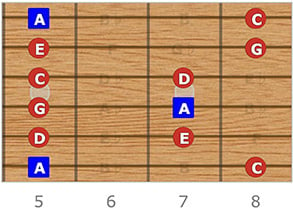
Looking at this shape it may appear like there are more than 5 notes in the diagram. You would be right that it does play more than 5 notes, but it doesn’t play more than 5 unique notes. If you look at the note names, it says A, C, D, E, G then A again. This is an octave, a note with the same name that sounds higher or lower than the first note. The pattern then repeats. On the high E string, we get A and C again. So the scale has 12 total notes, but only 5 unique notes.
The pattern goes fret 5 to fret 8 on the low E string. Then fret 5 to fret 7 on the A through G strings. Then fret 5 to fret 8 on the B and high E strings. This is a pattern you will want to memorize.
There are two ways we are going to practice this scale pattern. The first way is playing it from the lowest note to the highest note then back down. You start on the low E string, then play every note from left-to-right on the diagram. Once you do that, play it from the highest string to the lowest string. This time you play every note from right-to-left on the diagram. This is the up and down method.
The second way we are going to learn our Pentatonic Scales is the improvisational method. This is where we will pick random notes from the Pentatonic Scale while we practice. Here is how it works. Put on a metronome or backing track, then play the notes from the Pentatonic Scale we just learned. Every note should be played on a quarter-note rhythm, one note per beat. But, you don’t want to play the scale up and down like we did in the first method. You want to pick random notes in the scale. This will help you learn to improvise instead of doing an exercise. Skip strings, play 3-note patterns, and do whatever you think sounds good. The goal is to learn to improvise the scale.
Important Note: The quarter-note rhythm won’t sound like a true solo. You want to vary the rhythm. Check out this article to learn more.
Playing the Pentatonic Scale in any Minor Key
Now that we know the Am Pentatonic Scale, what should we do if we wanna play a song in a different key, like Em? First we need to understand how shapes work on guitar.
On guitar, you can change the key of a riff, song or melody by playing the same pattern on a different fret of the neck. If you want to play an Em Pentatonic Scale, you can play the exact same scale shape at a different spot on the guitar neck. Here it is:
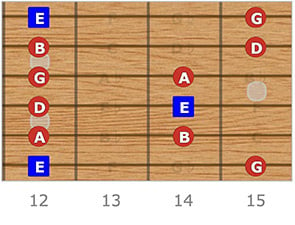
The Em Pentatonic Scale starts on the 12th fret of the low E string. (You can also start on an open string, but open-string scales are harder at first.) Then it follows the exact same shape as the Am Pentatonic Scale. This means that once you know the Am Pentatonic Scale, you know every Pentatonic Scale.
The next question is, can I play this in other keys besides Em and Am? The answer is yes. The first note of the scale is the minor version of the scale. The 12th fret of the low E string is E. The 5th fret of the low E string is A. This is where each scale starts. So, you need to memorize the notes on the low E string. Here they are:
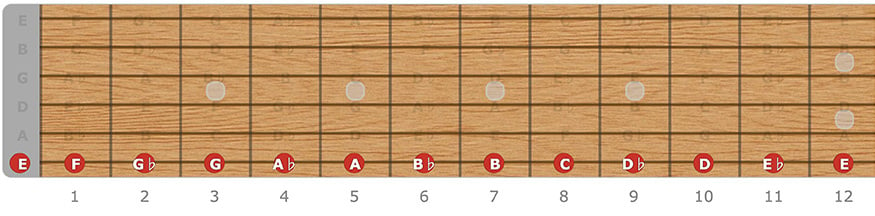
Start by going up and saying each note on the low E string. Then start on the 12th fret and go backwards. This will help you memorize the note pattern, but you want to learn the notes without counting each fret. This requires practicing it in different ways. The next step is to practice skipping notes. Try naming each note that has a fret dot. Once you are comfortable with the dots, recite the note names between the dots. Learning these note names is very important for several different skills on guitar. The first is learning your Pentatonic Scales. But you can also learn your barre chords this way.
Playing the Pentatonic Scale in any Major Key
Now that you know how to play any Minor Key, we need to learn how to play the Major version. The easiest way is just to figure out which Minor Keys and Major Keys go together. The Major that works best with the Minor is the 2nd note of the Pentatonic Scale. In Am, it’s C. In Em, it’s G.
You can figure out which Minor Pentatonic to play from a Major Key by going down 3 frets from the given key. So if you’re playing a song in D Major, go 3 notes down then play that Minor Pentatonic. In the case of D, it is the Bm Pentatonic Scale. Can you figure out which Minor Pentatonic goes with E Major?
The Theory of the Pentatonic Scale
The Am Pentatonic shape gets you soloing fast, but it only covers part of the guitar neck. Watch any guitarist you admire and you'll notice they don't stay in one shape. They move across the whole fretboard and it sounds effortless.
Here's how they do it. The notes of the Pentatonic Scale exist all over the neck, not just in the one shape you learned. Once you can play a key in that one shape, you're ready to see where those same notes show up everywhere else. That's the Major Scale.
The Major Scale isn't a different scale. It's the Pentatonic Scale plus two more notes. Those two notes are the hardest ones to use well when you're still new, which is exactly why we started without them.
If you're ready for that next step, grab your copy of the Orange Roxy Rockin' Guitar book and start learning the Major Scale.


