
How to Solo on Guitar
Stuck on Tabs
Learning how to solo on guitar is one of the most enjoyable and difficult things you will ever do. It's fun to play with other people soaring lead lines and riffs that you made up, but it is very hard to learn how to do it well.
Most guitar players open up tabs and learn note for note solos. This is important for learning how to play guitar, but if you know how to make your own, you will get even better. This is improvisation.
There are 3 skills players need to master to improvise:
- Volume
- Pitch
- Rhythm
Most guitar players try to learn all three skills at once. It is much easier to focus on one area at a time before trying to master all three.
Volume
Volume is how loud you play a note.
Musicians often talk about playing dynamically. Dynamics are changes in volume over time. If you play each note in your solo at the same volume, you are not playing dynamically. This is important because non-dynamic solos sound boring.
Here’s what to practice: Go home and solo over some songs. Find one note that sounds good over the solo. Play it quietly in the beginning and increase the volume as your solo goes on.
Playing one note lets you focus on the volume of your solo. Now let's focus on the notes of your solo.
Pitch
Pitch is the notes played on guitar. But what notes sound good when soloing. This is why learning scales are important. It helps us understand what a good starting place for soloing. If you don’t know any scales, we will start with a simple pentatonic scale.
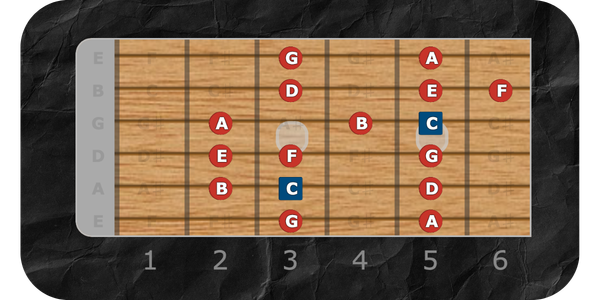
This is the Am Pentatonic Scale. You can use it to solo over songs in the key of Am or C. There are 2 ways to practice this scale. The first one is simple.
Start on the Low E string and play all the notes in the diagram from left to right. Then go to the A string and do the same. Follow the pattern on each string. When you get to the last note on the High E String, play it backwards. Play all the notes again but right to left. Play the pattern all the way back down to the Low E string.
Once you are familiar with the pattern, play it with a beat. Put on a drum groove or a metronome and play quarter notes with each note.
Once you can do that, you are going to start improvising which notes you play. Keep the drum groove going and play the scale using random notes. Instead of going up and down like before, play random notes from the scale. Make sure to only use quarter notes.
Once you are comfortable doing this at about 150 beats per minute, you are ready to move on. This can take weeks to months to get down.
Rhythm
Rhythms are often considered the most important part of music. Because a wrong note played at the right time can sound good. But the right note played at the wrong time will often sound terrible. This means that mastering rhythm is very important for your guitar playing.
Rhythm has two components: when play notes and when you stay silent. Both are very powerful. Silence is often underestimated, especially in solos. But the same time constraints work for both.
It is important to understand rhythm terms so we can communicate well.
A measure is how we group notes together.
Quarter notes last 1 quarter of a measure. You’ve probably heard a song that counts to 4. Like 1, 2, 3, 4. Each count of that measure is a quarter note.
Eighth notes are shorter than quarter notes. There are 2 eighth notes for every quarter note.
Sixteenth notes have two notes for every eighth note or 4 notes for every quarter note.
If you want a more in-depth breakdown on how rhythms work, fill out this form for the green Roxy Rockin’ Guitar Book!
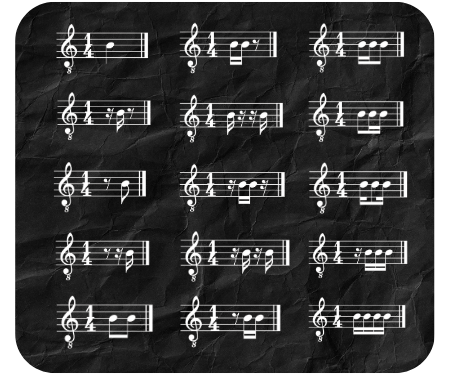
This chart comes from our Orange Roxy Rockin’ Guitar Book.
It is every 16th note based rhythm possible within one beat.
The first thing to do to start mastering rhythm is to solo using one note. Play a solo using only one note and play every rhythm in the chart. After that, try and make your own rhythm up with one note.
Then once you can play your scales, take the scale exercise and play each rhythm in the chart. This means for each rhythm you practice playing random notes from your scales.
Once you master this, soloing will be much easier. Most solos combine combinations of each of these rhythms to make something great.
If you want to dive deeper on soloing, go to the link and fill out the form.
Select the option, "I can solo using my pentatonic scale," to learn the next steps after this article.


