
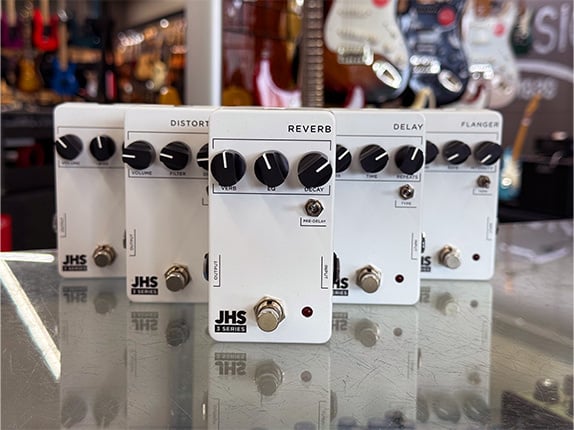
JHS 3 Series Pedals: Complete Guide to Every Sound
The JHS 3 Series
Have you been dreaming of building a pedalboard? Does the idea of building it piece by piece to create the tone of your dreams excite you? But every time you look at pedal prices the dream seems out of reach? The JHS 3 series might be for you. JHS is one of the best pedal brands on the market. The founder Josh Scott knows more about guitar pedals than most human beings on the planet. The pedals he builds are outstanding. I have two JHS pedals on my own pedalboard. The 3 Series pedals offer the quality of JHS for $99 each. These are some of the cheapest pedal options on the market.
The 3 Series pedals have pretty much every sound you can imagine. They have standard effects like Reverb, Overdrive or Delay. They also have more unique effects like Rotary Chorus and Glitch Delay. There are three categories of pedals that the 3 Series has.
-
Overdrive, Distortion & Fuzz
-
Delay & Reverb
-
Modulation Effects
Overdrive, Distortion & Fuzz
Overdrive, Distortion and Fuzz effects all happen from clipping. Clipping is when the volume going into a circuit sends more signal than the circuit can handle. This causes the audio to change. If you want a more in-depth article on how overdrive sounds work, click here.
3 Series Overdrive
The 3 Series has four different options of Overdrive, Fuzz and Distortion. The first is the simple overdrive circuit that gives you a wide range of overdrive options. It has three knobs that affect the tone: Volume, Body and Gain.
-
The Volume changes how much volume comes out of the pedal.
-
The Body is an EQ knob. It affects the tone of the pedal.
-
The Gain determines how much drive comes out.
[products=3seriesoverdrive]
3 Series Distortion
The 2nd pedal is the Distortion pedal. It works basically the same way as the Overdrive pedal, but the circuit inside the pedal is different. Distortion pedals have more gain than overdrive pedals do. The knobs on the Distortion pedal have different names, but do the same things.
-
The Volume knob changes the output volume.
-
The Filter changes the tone.
-
The Distort changes how much distortion there is.
[products=3seriesdistort]
3 Series Screamer
The 3rd pedal is the Screamer pedal. It is based on the Ibanez TS9 pedal, but it takes Josh Scott's ingenuity. He used to mod TS9 pedals for customers. This led to a massive journey of Tube Screamer versions made by JHS that led to the 3 Series Screamer. It is the exact copy of his modified version that he used to make. It has a Volume, Tone and Drive knobs. The knobs do the same thing as the other two pedals. It also comes with a positive and negative switch. It basically adds more headroom than the original TS9. This allows guitar players to add more drive to the pedal before it distorts.
-
The Volume knob changes the output volume.
-
The Tone changes the tone.
-
The Drive adjusts the level of overdrive.
[products=screamer]
3 Series Fuzz
The 3 Series Fuzz pedal is the last pedal we will cover in this series. It has a Fuzz, Bias and Volume knobs. The fuzz is like a distortion, but the sound is based on a broken amplifier sound.
-
The Volume changes the output volume.
-
The Bias knob creates a gated sound as you turn it up. This means that it limits low volume sounds from coming through.
-
The Fuzz knob works like the distortion and gain knobs from earlier.
[products=3seriesfuzz]
Delay & Reverb
Delay and Reverb are time-based effects. They affect time by repeating the signal sent through it. Reverb replicates the sound in rooms. Have you have been in a hallway or giant room that made your voice sound massive by repeating what you said? This is reverb. Delay is when you have a note that repeats several times. If you wanna learn more about delay and reverb, check out this article. The 3 Series Delay and Reverb pedals have too many options to cover each one in this article. This will just be an overview of how they work.
Reverb
The basic Reverb pedal has Verb, EQ, and Decay knobs. The switch is pre-delay.
-
The Verb knob determines how much dry signal versus wet signal there is. Dry signal is the guitar without reverb. Wet signal is the reverb signal. If the wet signal is all the way up, it will mostly be reverb signal with very little actual guitar signal. If it is all the way down, it will have very little reverb signal.
-
The EQ affects the tone of the reverb. Do you want the reverb to sound bright or dark?
-
The Decay determines how long the reverb lasts. If the decay is short, it will become silent quickly. If it is long, the reverb can feel like it goes on forever.
-
The Pre-Delay switch determines if there is a delay before the reverb signal comes. If it is on, you will have dry signal followed by wet signal. If it is off, the wet signal will happen immediately.
[products=3seriesreverbs]
Delay
The basic delay pedal has a Mix, Time, and Repeats knobs. It also has a type switch.
-
The Mix knob determines how much of the volume going out of the delay pedal is dry or wet. This is like the Verb knob on the Reverb.
-
The Time knob determines the interval on which the notes repeat. The first repeat often happens about 300ms after a note is played. Then 300ms after that the 2nd repeat happens. The time knob adjusts the 300ms number.
-
The repeats knob determines how many repeats the delay has. The more you turn up the knob, the more repeats you have. Play a quick note, then mute it. You can hear how many repeats happen.
-
The type switch lets you choose between a digital delay and an analog delay.
[products=3seriesdelay]
Modulation Effects
Modulation Effects basically alter the sound wave. Modulation effects typically change the wave in unique ways. There are four modulation effects that we will cover in the 3 Series.
3 Series Rotary Chorus
The first pedal in the Modulation Effects is the Rotary Chorus. It is based off the Hammond B3 Leslie sound. It is basically a speaker going around in a circle. The effect sounds like panning. It will make the sound go from one side of your headphones to the other. It repeats this pattern, creating the Leslie effect.
It has Volume, Intensity, and Speed knobs with a room toggle switch.
-
The Volume knob determines how loud it is.
-
The Intensity knob determines the level of modulation. Modulation is when the tone of a signal is changed. In this case, it is a chorus pedal. Chorus pedals make something sound like it is being played twice. It copies the audio signal and then slightly detunes the copied signal. The Intensity determines how much it is detuned.
-
The Speed knob determines how fast the speaker is spinning.
-
The room switch adds a slight reverb.
[products=3seriesrotary]
3 Series Harmonic Tremolo
The 2nd pedal is a Harmonic Tremolo. A tremolo pedal is a pedal that lowers and raises the volume of the signal sent. The Harmonic Tremolo takes the idea and changes it a little bit. Instead of raising and lowering the volume, the tremolo changes the tonality. It splits it into a high-frequency path and a low-frequency path. Then it goes back and forth between the two. This is the Harmonic Tremolo. It has Volume, Depth and Rate knobs. The switch determines the type of tremolo.
-
The Volume determines how loud it is.
-
The Depth determines how far it changes the frequency. A low depth will have a subtle frequency shift. A high depth will have massive frequency changes. When the type switch is set to normal tremolo, the depth knob affects the volume of the signal.
-
The Rate determines how fast it moves through the frequencies.
-
The type switches between a normal tremolo and a harmonic tremolo.
[products=3seriesharmonictrem]
[products=3serieschorus]
3 Series Phaser
The 3rd pedal is the 3 Series Phaser. It is a basic phaser pedal. The phaser effect copies the original signal then does a filter sweep on the copied signal. This means it basically raises the high frequencies, then the mid frequencies and finally the low frequencies. Then it goes back the other direction. It is a super popular effect that Van Halen uses in You Really Got Me.
The Phaser has Blend, Rate, and Width knobs. The switch is a feedback switch.
-
The Blend determines how loud the wet vs dry signal is.
-
The Rate determines how fast the frequency sweep moves.
-
The Width determines how far the frequency sweep is. The wider it is, the lower and higher the frequency sweep will go.
-
The Feedback switch sends the phased signal back into the phaser to cause more madness.
[products=3seriesphaser]
3 Series Flanger
The last pedal in the Modulation section is the Flanger. It copies the original signal and delays it slightly. It then uses a Low-Frequency Oscillator (LFO) to change the tone. It has Blend, Rate and Intensity knobs.
-
The Blend knob determines how much of the flanged signal is sent vs the dry signal.
-
The Rate determines how fast the LFO is moving.
-
The Intensity determines how deep the flanged signal oscillates.
The tape switch goes between a modern flanger sound and an emulated tape delay sound. The tape delay is how flangers were created. JHS emulates that sound in this pedal.
[products=3seriesflanger]
There were a lot of different options covered from Overdrive to Modulation. The best part is that every pedal mentioned above is currently $99. If you are ready to start building your pedalboard on a budget, the JHS 3 Series has everything you need. What are you waiting for? Get started on your pedalboard today at Roxy Music: JHS 3 Series.


