

How to Play Guitar Triads: Chord Shapes You Already Know
Guitar Triads
Have you ever heard some beautiful chords on guitar, but can’t seem to replicate them? You may have seen some of your favorite guitar players use beautiful chords. Learning some of these chord voicings takes years of practice. The next step to getting there is learning triads. Triads give you unique chord voicings that sound beautiful in every key. The best part is that they are based on chord shapes you already know.
There are three things that we will cover to learn triads:
-
What is a Triad?
-
Triad Shapes
-
Using Triads in a Key
What is a Triad?
Chords are the lifeblood of music. Everything uses them. Rock bands use them to add power behind the vocal melody. Choirs use them by having different vocalists sing different notes. And piano players play chords and melodies at the same time. A chord is built with 3 notes. The first note is the root of the chord. In a major chord, the second note is a major 3rd (4 frets) above the root. The third note is a perfect fifth (7 frets) above the root note. Playing all 3 notes at the same time is a triad. This is the most basic version of a chord.
Guitar players aren’t used to playing triads because they rarely play them. Take the basic G chord. Start on a G note. A major 3rd above G is B. (G#, A, A#, B is four frets). A perfect fifth above G is D. Here is the first G chord most guitar students learn.
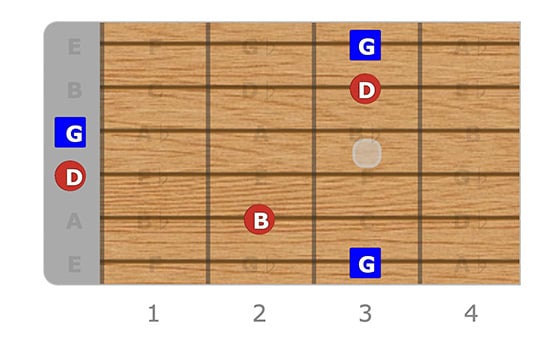
You are using all 6 strings. This means you are playing 6 notes not 3. This happens because the G chord doubles notes.
Guitar triads are useful because they limit the amount of noise coming from the guitar. Instead of 5 or 6 notes, you play three. This is very useful when there is a full band.
Triad Shapes
Now that you know what a triad is and why guitar players rarely use them, it's time to learn the shapes of a triad. Since a triad has 3 notes, you will only be using 3 strings. How many sets of 3 strings are on the guitar? Be careful, it’s kind of a trick question.
The obvious guess would be 2 string sets. Because 6 divided by 3 is 2. But, there are 4 sets of 3 strings on the guitar. The 1st set is the E, B, and G set. The 2nd set is the B, G, and D set. The 3rd set is the G, D, and A set. Finally, the 4th set is the D, A, and E set. Each set has 3 major triad shapes and 3 minor triad shapes. These shapes are used in every key. So, you only have to learn 12 chords to play triads in any key.
This article will only cover the first two string sets. They are the most important for learning.
String Set 1
Major Triads
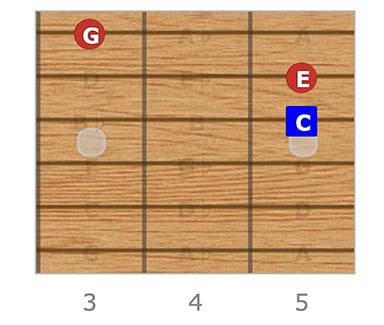 - C Major Triad 1
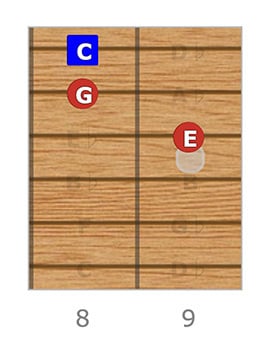 - C Major Triad 2
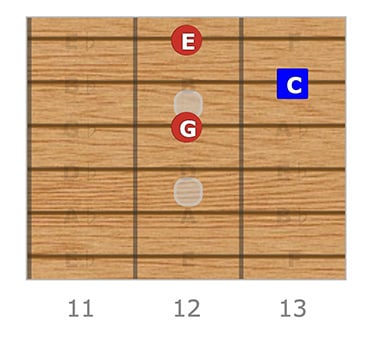 - C Major Triad 3
Minor Triads
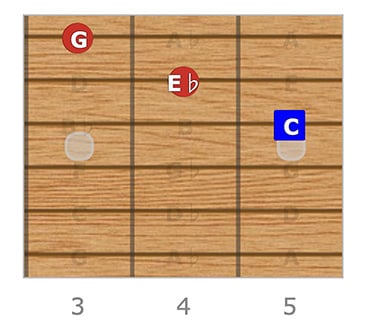 - C Minor Triad 1
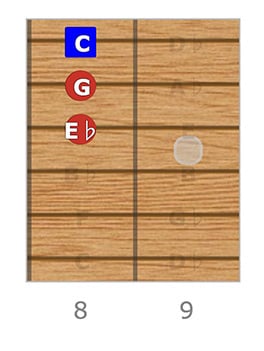 - C Minor Triad 2
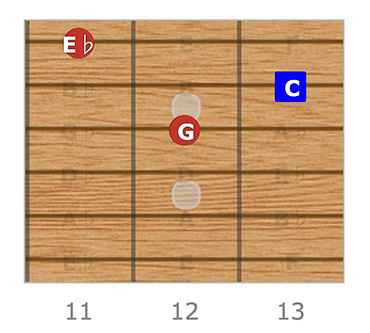 - C Minor Triad 3
The secret to learning how to play these shapes in any key is knowing where the root notes are. The root notes do not change for major and minor shapes. The shape number applies to both the major and minor shapes. In the 1st shape, the root note is on the G string. If you wanted to play this chord as an F chord, you would move the G string note to the 10th fret of the guitar instead of the 5th. This shape is based on the A cowboy chord using only the top 3 strings.
The 2nd shape has the root note on the high E string. You can play a G chord by lowering that shape from the 8th fret of the guitar, to the 3rd fret of the guitar. This shape is based on the E major chord using the top 3 strings.
Finally, the 3rd shape has a root note on the B string. You can play an A chord by moving that shape from the 12th fret of the guitar to the 10th fret of the guitar. This one should be obvious what it is based on. It is a D chord.
String Set 2
Major Triads
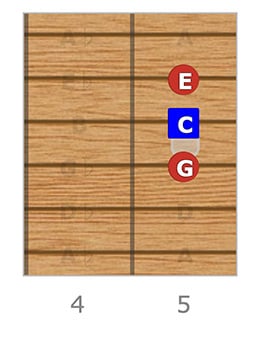 - C Major Triad 1
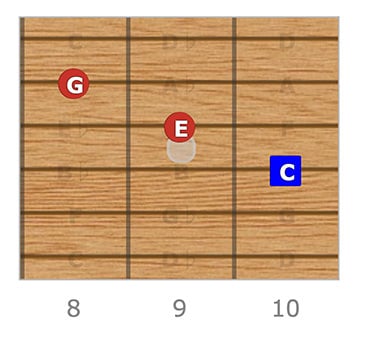 - C Major Triad 2
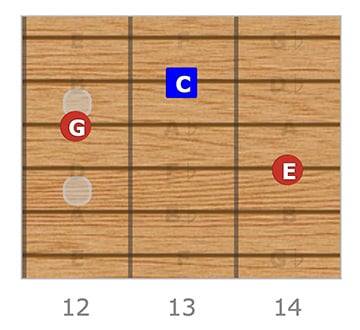 - C Major Triad 3
Minor Triads
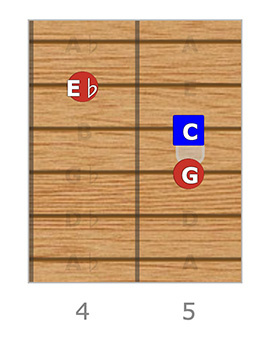 - C Minor Triad 1
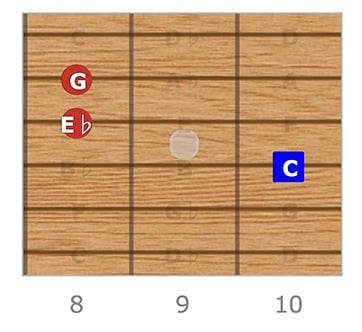 - C Minor Triad 2
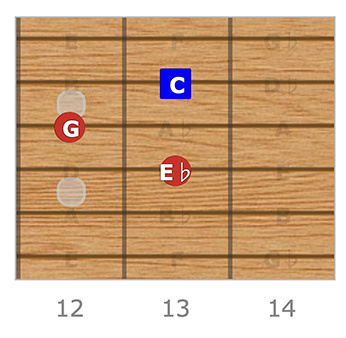 - C Minor Triad 3
These shapes are also C chords. This string set is the most important string set to learn. In the next section, you will see how to use these chords in 90% of songs very quickly.
The 1st shape for the major and minor triads is based on an A chord. It should be obvious. The root note is on the G string. If you want to move it, you can do it by finding the note name that matches on the G string. If you want to play an E chord, move from the 5th fret to the 9th fret.
The 2nd shape is based on the non-barre version of the F chord. The root note is on the D string. So you can move it by finding another note on the D string. If you want to play a Bb chord, move the shape from the 10th fret to the 8th fret.
The 3rd shape is based on a C chord. The root note is on the B string. If you want to move it, find the chord you want to play on the B string. For example if you want to play a Db chord, go from the 13th fret to the 2nd fret.
Using Triads in a Key
This triad trick will help you play triads in any key, but you need to know some basic music theory for it to work. Each music key has 7 triads that you can use without playing outside of the key. But, most music usually only uses 4, the One chord, the Four chord, the Five chord and the minor Six chord.
These chord numbers come from the major scale. But, you can figure them out by just using the alphabet and a chord chart. Each key uses every letter from A-G. This means that you won’t have a B chord and a Bb chord in the same key. (Sometimes people write chord charts incorrectly, but there should be no repeat letters).
Take the root note as One, then go up the alphabet to figure out each chord. The chord chart will tell you if it needs to be sharp, flat or natural. Try C and F. Your goal is to find the One chord, Four chord, Five chord and Six chord. The One chord is C. What is the Four chord? Go up the alphabet. D is Two, E is Three. F is Four. G is Five. A is Six.
Now try F.
F is One. B is Four. C is Five, and D is Six. When you look at a chord chart, it will give you Bb instead of B. Play that. You are just trying to find the letter.
Now that you can find numbers for the chords, you can use triads to play in any key. Start with C. The chords you want are C, F, G, and A minor (Am). Play C on the first shape of the second string set. The A shape.
Play the F chord using the 3rd shape of the second string set. You can get there from C by placing your middle and ring fingers on the B and D strings. Skip G and play Am by lifting up our middle finger. Finally, play G by sliding down to the 2nd shape of the second string set on the 5th fret of the D string.
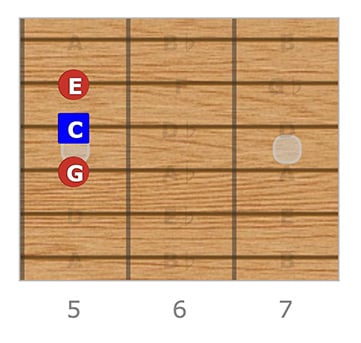 - C Major
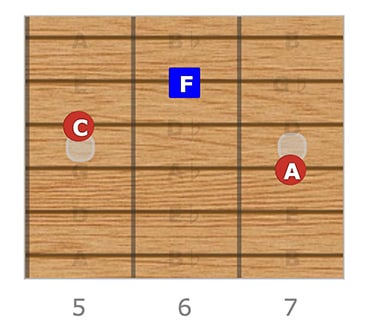 - F Major
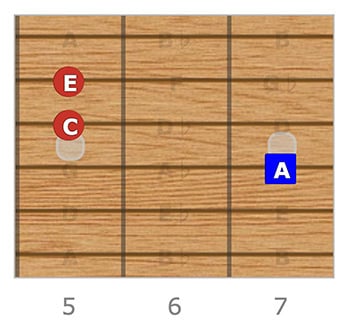 - A Minor
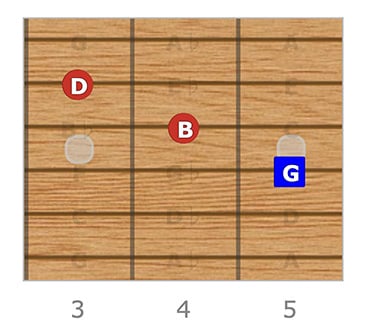 - G Major
This grouping works in any key. Here is the key of F as well. Can you figure it out in the key of D?
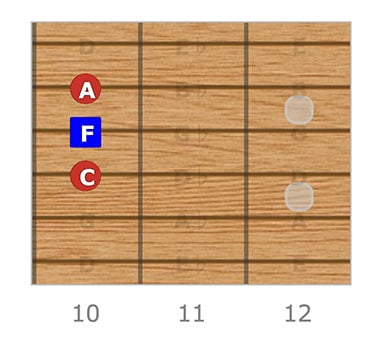 - F Major
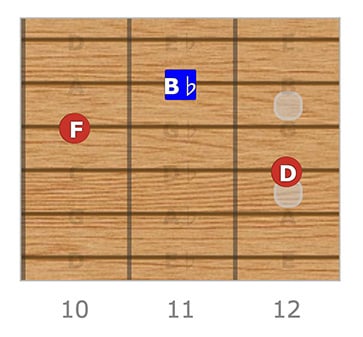 - Bb Major
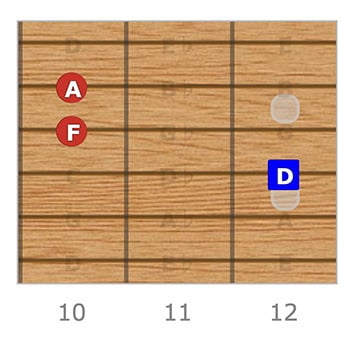 - D Minor
- C Major
Triads give you clean, moveable chord voicings without the extra noise of a full barre chord. Once these shapes are under your fingers, you can drop them anywhere on the neck and they'll sound right.
If you need help finding the chords, the Roxy Rockin' Guitar books have every triad shape for every chord. You can just look them up. Click the link and select the Orange book to get the first string set for every triad.


